Thursday, 18 December 2008

Everything left open

(click on the image to enlarge) 

The areas coloured in orange represent the critical down-flooding openings, which were deemed to have played a part in the loss of the Gaul.
The areas coloured in blue (the funnel vents) are also critical in the down-flooding scenario, although these are meant to be kept open at all times.


The duff and offal chutes were found open on the wreck. The 2004 RFI concluded therefore that they had been left open by the crew.
As we have attempted to demonstrate on these pages and in the attached documents, the chutes’ outer flaps had a design fault, while their inner covers could not provide sufficient protection against flooding.

The fish loading hatches and the net store hatch, as our previous post explained, could have been opened by air pressure or by the force of internal floodwater acting on them from inside the vessel.
The RFI panel’s opinion, however, was that these hatches, also, had been left unsecured by the crew and had opened due to gravity when the vessel was sinking.

The engine room escape door, the RFI surmised, had been opened by one of the crew when trying to escape from the lower deck at the time of the incident.
In the absence of any contrary evidence, the hypothesis that this door had been opened by air pressure is again more probable.

The RFI panel concluded that the access door to the accommodation space, also, had been left open by the crew; and we can contend again that trapped air pressure or internal floodwater pressure could have opened it just as well.

As to the factory deck access door the RFI concluded, this time on the basis of some tangible evidence, that the crew had failed to secure it in the closed position.
All in all, the only conclusion we can draw from the dubious RFI findings is that the 2004 investigation panel was too eager to suggest a pattern of widespread crew negligence and to lay the blame for the loss of the Gaul on the victims to bother about plausibility.

Ignoring the existence of alternative explanations, underpinned by simple scientific principles, the RFI panel chose to put forward a loss scenario that was not only unsupported by any credible evidence, but also defied common sense.

The fish loading hatches

In 1999, in the year following their first underwater survey of the wreck of the Gaul, the MAIB produced their Marine Accident Report no. 4/99.
Amongst other things, this report put forward the MAIB’s hypothesis as to why the two large fish loading hatches on the Gaul had been found open during the survey. This stated that, at the time of the loss, the hatches had been unsecured and that they had therefore fallen open during the vessel’s capsize and sinking ’by the stern’.

As we have attempted to demonstrate in the document published at this LINK, the MAIB analysis, taken as read by the 2004 RFI panel, appears to have been seriously flawed.
The error it contains relates to one of the possible mechanisms that could have opened the fish loading hatches, namely, an increase in pressure of the air trapped between the water that was flooding into the vessel and the under side of the closed hatches.The MAIB report stated that the maximum lifting pressure on the underside of the fish loading hatches was only 478 N/m² (49 kg/m²), and that this would occur, for some unknown reason, when the vessel was exactly 80m below the sea surface. (!?)


A simple calculation can show, however, that if the Gaul had had a trim by the head of only 5ยบ [1] and had been submerged to merely two metres below the sea’s surface, the lifting pressure on the underside of each fish-loading hatch could have been of the order of 900 kg/m² (i.e. approximately 3.5 tonnes per hatch), while the self-weight of each hatch was approximately 0.9 tonnes.
This ‘error’ meant that one plausible scenario for the opening of the hatches was incorrectly eliminated from the formal investigation, while another similarly plausible hypothesis – the possibility of the hatches having been opened by the force of internal floodwater acting on the hatches from inside the vessel – was not even mentioned.
Here again, as in the case of the duff and offal chutes, the preferred explanation was crew error.
-----------------------------------------------------------------------------------------------------
[1] Although both the MAIB and RFI experts have concluded that the Gaul sank initially and sedately by the stern, this theory cannot be relied upon with any degree of certainty, as it does not take into account the dynamic loads and ship motions that the vessel would undoubtedly have experienced, whilst at or near to the sea’s surface and following the redistribution and loss of buoyancy that would have occurred, as it flooded and sank. At the time of the loss the weather was extreme, with a significant wave height of circa 10m and with infrequent individual waves of up to 19m in height.

Further clarifications

Following on from our previous post, we can add that the Treasury Solicitor has also informed us that:
“To my knowledge, Mr [D****] has not provided a final report and so it would be premature to assume that the formal investigation will not be re-opened.”

The report in question (TECHNICAL REPORT) is just one of the technical documents that we have provided so far. As everyone can see, this site contains additional evidence and links to several other relevant documents, which the DfT/TSol should have noted.
However, the Treasury Solicitor only referred to our first report (?!), which, he states, “as accessed via the Internet”, does not provide grounds for re-opening the investigation.

Evidence 'as seen'

Insufficient evidence’ is a common response these days to claims for due and proper investigation of high-profile misdemeanours, two magic words that have the power to open the doors to impunity.
We heard them in the cash-for-honours fiasco; we heard them used in several other affairs and now we hear them again with reference to the Gaul case.

Recently, the Treasury Solicitor himself made use of this ‘get-out’ formula when he advised the Department for Transport on the possibility of re-examining the shameful outcome of the 2004 Gaul Investigation.
The Treasury Solicitor, who, during the 2004 RFI, prepared and presented the case under directions from Lord Goldsmith, is now charged with assessing our criticisms of that investigation (published online for all to see).

When asked to justify his pronouncement, he simply told us that our evidence ‘as seen’ did not provide grounds for re-opening the investigation. Fullstop.
Evidence ‘as seen’…?! What could the meaning of this be? Why so inexplicit? Did he think that, if understood, his words would loose their mystical power; or was it just his way of reminding us that the government is too far above the law to have a clear vision of their tasks?

The laws of Physics

The 2004 Gaul RFI concluded that:

- The design of the duff and offal chutes on the Gaul was satisfactory to prevent the ingress of seawater onto the factory deck. (RFI final report, page 285)

- At the time of the loss, there was no physical reason why the watertight covers could not have been closed and secured. (RFI final report, page 286)

Additionally, it was assumed that, apart from leaving open the closures of the duff and offal chutes, the crew on the Gaul had also left unsecured a number of other important weathertight hatches and doors – all during a major storm. (!!!)
(This ‘everything was left open’ assumption was possibly meant to reinforce the RFI panel’s theory of crew negligence: i.e. if the trawlermen had left so many things unsecured, leaving the chutes open would be less surprising – just part of the general pattern.)

But why would the 36 experienced crewmembers do such reckless things? Save for the unlikely possibility that they all ran amok that day, what explanation could there be for such weird behaviour?
Yet, the 2004 Investigation panel decided that the crew had ignored all those protections to the safety of their ship and of their own lives.
No scientific explanation was found, although simple scientific explanations do exist - if you are willing to look for them.

In support of these alternative explanations, we are able to present the evidence given by our expert witnesses: Sir Isaac Newton, Messrs Archimedes of Syracuse and Robert Boyle.
The physical laws established by these honourable gentlemen could be used to prove the existence of alternative loss scenarios. We have already done this for the closing arrangements on the duff and offal chutes on the Gaul, which, we demonstrated, could have easily been opened by the forces of the sea. Bearing in mind that these laws govern cause and effect, it can be similarly demonstrated that a number of other important hatches and doors on the Gaul could have been burst open by the maelstrom of forces unleashed on them as floodwater surged from compartment to compartment, while the vessel was sinking in heavy seas. (More about this will be said in a separate post)

However, once one accepts that other plausible explanations exist, the general crew-negligence scenario, that the 2004 RFI panel seem to have stapled themselves to, becomes increasingly doubtful. To say the least...

Brief statement

Mr Tony Bowman - Managing Director of TMC (Marine Consultants) Ltd was the technical expert appointed by the Attorney General to ensure that all relevant technical evidence was presented to 2004 Re-opened Formal Investigation (RFI) and to provide expert advice on the matters related to the loss of the Gaul.

Today I called Mr Bowman and asked for his opinion on the evidence related to the design defect in the duff and offal chutes on the vessel - evidence that had been produced by the MCA and available to those concerned since 2002.

The TMC Director would offer no comment on the matter other than stating that all he had to say about the design of the Gaul’s chutes was contained in the transcripts of evidence and RFI final report.

Well, we’ve already seen them… That's why I was asking.

A second design error

So far, we have revealed that there were two design faults and one, what we would call, error in the in the design of the duff and offal chutes on the Gaul:
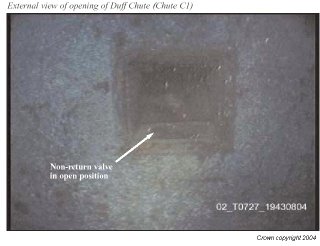
The principal design fault (for details, see this LINKED DOCUMENT and this VIDEO CLIP), related to the construction and arrangement of the chutes, meant that the non-return flaps in the duff and offal chutes on the vessel could have been opened by the action of the sea

The second design fault showed the possibility for the bolted assemblies of the non-return flaps to become twisted due to the force of the sea, and remain open thereafter (further details can be found at this LINK).
The design error described in our post of 26 June 2007 was a dimensioning mistake in the shipyard’s construction drawing which, in certain circumstances, could have caused the flap to jam in the open position, after having been opened under the action of the sea. (For further explanations please follow this LINK)

Now, we are presenting yet another design error (explained HERE as well as HERE): a miscalculation of the relative weights of the components of the chutes’ non return flaps, the consequence of which meant that a wave load of only 7.5 kg could have been enough to force them open.

It should be noted that the design of ‘non-return flaps’ within the duff and offal chutes should have enabled them to withstand the forces of the sea, close automatically and prevent water ingress. However, as a result of the inadequacies listed above, the action of the sea could have caused the flaps to fail in their main functions.

Thus, it is evident that the design of the Gaul’s chutes was vitiated by multiple flaws (and, we warn you, there is more to come) and that the unfortunate nature of these flaws was such that they augmented each other’s effects, rendering the vessel unacceptably vulnerable to flooding and capsizing.

RFI experts' report

In our posts of 28 April and 03 May, we reported on the difficulties of obtaining a document held by the Department for Transport (DfT) – the joint report of the experts in the 2004 Formal Investigation into the sinking of the trawler Gaul.

On 26 June 2007, in a letter sent to Sandra Gidley MP in response to her similar request, Dr Stephen Ladyman, Minister for Transport at that time, wrote:
“The report referred to in paragraph 8 of the Expert’s Protocol is not in a form that can be easily reproduced or transmitted in its entirety. I would be happy to send you any relevant excerpt if you could submit a more specific request for information.”

One month later, on 26 July 2007, in a letter on the same topic, the DfT takes a different approach:
“The Department has sought advice from the Treasury Solicitor’s office on the status of the Joint Panel of Experts report and has been advised that it is not a public document. It was referred to at the RFI but only the transcripts of the various experts oral evidence were actually placed on the GAUL website.
Furthermore, it is accepted that the material prepared for the RFI was prepared on behalf of the Attorney so strictly the Joint Report is the property of the Attorney.
However, the Department can see no difficulty in providing your naval architect with an opportunity to view the Panel’s report but he should be advised that it is not a public document and it will be provided only on the basis that it remains confidential and the property of the Attorney.“
Questioned further on this subject, the Head of Shipping Policy in the DfT told us that the report in question was so confidential that no copy or reproduction of its contents or of any part of its contents was permitted.

Why cannot the public view a technical document, which was created in the course of a public investigation that cost the taxpayer about £10 mil? Although the public paid for it, the record is now owned by the Attorney General who would not even release copies of parts of the document for research and public interest purposes.

Stability issues

IMCO’s [1] ‘Recommendation on intact stability of fishing vessels’ states:
(10) In cases where the ship would sink due to flooding through any openings, the stability curve should be cut short at the corresponding angle of flooding and the ship should be considered to have entirely lost her stability.
The Gaul sank due to flooding started at the duff chute opening, when this became immersed at a heel angle of only 26ยบ (see RFI final report Para. 17.5, page 245).


This angle of heel, at which the Gaul’s stability disappeared, was in breach of IMCO’s recommended criteria for the stability of fishing vessels which requires that a vessel should have sufficient stability at angles of heel beyond 30ยบ.

----------------------------------------------------------------------------------
[1] IMCO – Inter-Governmental Maritime Consultative Organization, now known as IMO

Letter to the MCA

The naval architect who was involved in the 2004 Re-opened Formal Investigation into the sinking of the FV Gaul, and is the author of the technical documents that have been published on these pages, has sent a formal email/letter to his employers: Mr Peter Cardy, the new CEO of the Maritime and Coastguard Agency (MCA), Mrs Ruth Kelly (the new Secretary of State for Transport), Mr Laurance O’Dea (Treasury Solicitor) and two other managers within the MCA.

The text of the communication is reproduced below:

Subject: Trawler Gaul

Dear Mr Cardy,
I would like to present you with a problem, the solution for which appears to lie within the gift of both the MCA and the Department for Transport.

The problem stems from the outcome, in December 2004, of the Re-opened Formal Investigation (RFI) into the loss of the Trawler Gaul, the principal issue here being that the results of this public inquiry do not correspond with the evidence that was made available before it.
Although in the normal course of events, the MCA should not and would not be questioning the conclusions of a legal process that has been conducted by the Attorney General's office, in this case, however, there is clear evidence that a miscarriage of justice has occurred.
As you may be aware, this issue is not new, having previously been raised with the MCA, the DfT, the Minister for Transport (via parliamentary questions), the Admiralty Judge who ruled in the RFI and the Treasury Solicitor/Attorney General's office. However, their collective response to date has been either unsatisfactory or to ignore it, probably in the hope that the objections will eventually go away.
I am a Corporate Member of the Royal Institution of Naval Architects and a Chartered Engineer. This Institution's byelaws state that:
Every Corporate Member shall at all times so order his/her conduct as to uphold the dignity and reputation of his/her profession and to safeguard the public interest in matters of safety and health and otherwise.
I consider it unacceptable that being in the Government's employment has brought me into conflict with the standards that are demanded from members of my profession. Furthermore, I find it ethically reprehensible that despite the serious failings in the conduct of this formal investigation, which are apparent, the government has not, as yet, thought fit to remedy this.
To conclude, I do not wish to remain an unwilling party to this miscarriage of justice and I would, therefore, be grateful if you could formally raise this matter with the DfT. with a view to bringing about an appropriate resolution to the case."

When contacted on the phone (several times), Ruth Kelly’s office refused to make any comments on this subject.

COPY OF THE ABOVE MESSAGE WAS ALSO SENT TO THE PRIME MINISTER’S OFFICE.

A design error

"18.17... it is important to note that although both chutes were found on the wreck to be open both in way of the non-return flap and the internal top cover, there is no known mechanical reason why this was so." (Report of the 2004 Re-opened Formal Investigation into the Loss of the FV Gaul)
In the paper describing the MAIN DESIGN FAULT on the Gaul, we gave an account of how the closed flaps of the duff and offal chutes on the vessel could have been forced open by the sea at the time of the incident. (You can also see a model of the design fault captured on this VIDEO clip).

Furthermore, the factor tree analysis diagram, published earlier on THIS PAGE, presented a range of alternative explanations, as to how the outer flaps of the duff and offal chutes on the Gaul could have become open and remained in the open position (the RFI having only examined and accepted that the flaps were open, prior to the vessel’s departure from Hull, as a result of corrosion and lack of maintenance).
One of these alternative explanations (i.e. THE SECOND DESIGN FAULT), mentioned in an earlier POST, put forward the possibility that the bolted non-return flap assemblies within the chutes could have become twisted due to wave action and remained open as a result.

Today, we are presenting another alternative explanation, whereby a simple dimensioning error in the shipyard’s construction drawings meant that, if ever the brass gland within the flap hinges was loosened by the operation of the flap, parts of it could have bound together, thus causing the flap to remain seized in the open position.
THIS PAPER gives the details. (The document can also be viewed HERE)

Meanings

Some of those who have read our previous POST may wonder whether the definitions used in the 2004 Gaul RFI were tailored to suit the conclusions of the investigation or whether they were just an unfortunate mistake that, it so happened, had a serious impact upon the outcome of the inquiry.
We cannot provide an answer in this respect, but we can supply some additional information:

- The definitions for ‘watertight’ and ‘weathertight’ are common knowledge amongst marine professionals, so it would be unreasonable to assume that the panel of experts in the Gaul RFI were not familiar with these classifications.

- Justice David Steel, the Admiralty judge, who conducted the formal investigation into the loss of MV Herald of Free Enterprise (1987), seemed, at the time, to be well aware of the correct meanings of the terms:
“[the term]…Watertight is applied to doors and bulkheads where there is the possibility of water accumulating at either side. Weathertight applies to doors or openings, which are only required to prevent the ingress of water from the side exposed to the weather.”[1]

------------------------------------------------------------------------------------------------------
[1] David Steel Q.C., mv Herald of Free Enterprise, Report of Court No.8074

The purpose of re-writing definitions

In our first POST, dated 31 August 2006 and in the technical paper (pages 15, 26-30) published HERE, we showed how the internationally agreed definitions for ‘watertight’ and ‘weathertight’ (which lay down the required properties for certain ship’s fittings) had been altered in the final report of the 2004 Gaul RFI, by the Investigation panel, in a way that made them looser in requirements and application.

To recap, the RFI definition for ‘watertight’ did not contain the very specific and essential capability of preventing the passage of water in any direction under a head of water for which the surrounding structure is designed that the standard definition incorporated, while the definition for ‘weathertight’ replaced the statutory capability that in any sea conditions water will not penetrate into the vessel” with the less stringent requirement of ”being sealed to exclude water in normal sea conditions.

Now, you may wonder: why would the RFI panel do such a thing, of creatively re-writing these definitions, rather than simply reproducing the standard ones from the Load Line and other Conventions?
If one looks at this problem in the whole context of the investigation and its outcome, then it becomes apparent that, without these alterations, the findings and the loss scenario that were produced by the investigation panel, would not have held water.
It was only according to these modified definitions that the inner covers of the duff and offal chutes on the Gaul could be categorised as watertight (in reality, these covers were not even of weathertight standard[1]).
Once having wrongly ascribed ‘watertight’ properties to the inner covers, it was then easy to claim, as the 2004 RFI did, that, had these covers been secured in the closed position, the flooding and subsequent loss of the vessel could have been prevented. As the Gaul’s inner covers were found to be open during the underwater survey, the blame for the incident was then immediately placed on the crew, thus avoiding any need for a further proper examination of the faulty outer ‘non-return’ flaps. (See VIDEO clip for a brief demonstration of the design fault)

Hence, we can only infer that: had the RFI panel not assigned properties to the closing arrangements on the duff and offal chutes of the Gaul on the basis of false criteria, they would have had to arrive at the same conclusion as others have: i.e. with the outer non-return flaps properly designed, the vessel would not have sank, regardless of whether the inner covers were open or closed.
----------------------------------------------------------------------------------
[1] Only in combination with the outer flaps were the inner covers intended to form a weathertight barrier to the sea. The role of the outer flaps was to provide a strength barrier against the force of the waves, and that of the inner covers to simply prevent the leakage.
----------------------------------------------------------------------------------

Reply from LRS

This is the reply received from Lloyd’s Register of Shipping in response to our recent enquiry about the Gaul:
Dear ******

Thank you for your email and explaining your position. The legal enquiry is complete on the Gaul and information passed to the MCA. It will be Lloyd's Register's intention to work with them should they decide to take this further. If the MCA or other official body contract you to study this and request Lloyd's Register to assist, then we will be happy to participate in such a study, but not before.

I wish you success with your research.

Yours sincerely,

*************

Marine Director
Lloyd's Register
This answer doesn’t sound, at all, like a statement of faith on the merits of the 2004 RFI. Does it?

Compliance with the rules (Part II)

In our previous post we indicated several non-compliances with the safety rules pertaining to the construction of the Gaul’s duff and offal chutes.


We are now reporting on further non-compliances with the rules, details of which have been published within this DOCUMENT.

Compliance with the rules (Part I)

In the email received from Lloyd’s Register of Shipping on 29 May 2007, it was stated that that the FV Gaul had been built in accordance with Class and statutory requirements.

Similarly, the final report of the Gaul 2004 RFI, states on page 10 that the vessel was built to Lloyd’s Register of Shipping classification +100 A1 (Stern Trawler), Ice Class III for the hull. In their letter dated 7 November 2006, the Department for Transport (DfT) also confirmed that the FV Gaul and her sister ships were built under Lloyd’s approval.

Prompted by these remarks and as promised in an earlier post, we have decided to set out the reasons why these assertions are not wholly correct. These and further clarifications in this respect have been published on this PAGE

The puzzle tour

We have often asked ourselves why such an obvious fault in the design of the Gaul had escaped the attention of scores of technical experts and assessors during years of legal battles and official scrutiny.
Why was this fault not noticed when the drawings were examined, immediately after the loss of the vessel?

Is it really possible that the design fault was, in fact, noticed?
Is it possible that the 2002 discovery of the design fault in the duff and offal chutes was, in fact, a re-discovery?

The labyrinthine trail of the Gaul’s history has eventually lead us back to the autumn of 1977 when, probably for the first time, the possibility of a problem with the chutes on the Gaul, as a likely cause for the loss of the vessel, was recorded. In a memo dated 14 September 1977, the Surveyor General in the Department of Trade (DOT) wrote:
It would indeed be a bonus if we not only located the GAUL but also established the cause of the loss. However, most evidence points to the GAUL being an intact ship, so we can give little guidance as to damage and I would expect small openings[1] which may have allowed the entry of water to the factory deck to be indetectable. The soundings also indicate the wreck which we suspect is the GAUL, is lying on its side…”
(Source RFI formal report paragraph 8.25)

On 22 December 1977, the NMI released to members of the DOT the report of their DOT-sponsored research into the sea-keeping and stability characteristics of the Gaul. These findings refuted the conclusions of the 1974 Formal Investigation by establishing that flooding of the factory deck would have been a precondition for the vessel’s capsize.

In a strange twist of logic, the results of the NMI research were subsequently interpreted as clearing the vessel’s builders and designers of any responsibility and, thus, the case[2] against them was dropped. In the whole maze of tangle and misdirection, this was probably a significant point. A supreme example of slothful induction, the decision implied that a design fault on the vessel could have only been contemplated if the capsize and sinking had been caused by water accumulated on the trawl deck - that is water accumulated on the factory deck could not have been put down to a design fault or construction error, but only to crew action or inaction. (?!)

During the 30 years of floundering and confusion that followed, no one managed to reach the centre of this circular labyrinth – the place where, as the legend has it, you will probably find a monster.

---------------------------------------------------------------------------------
[1] There were only two “small openings” capable of admitting water to the factory deck that would be undetectable if the vessel was lying on its starboard side: the duff and offal chute openings.
[2] In February 1997, a writ alleging negligence had been issued against the Gaul’s owners and its designers/ builders, Brooke Marine shipyard, by the families of the crew.

More about the main design fault on the Gaul

In an earlier posting we gave details of the main design fault that was present in the closing arrangements for the duff and offal chute openings on the Gaul (i.e. that that non-return flap plates opened the wrong way). In that posting we suggested that, if for any reason the flap valve was not fully closed, it could be opened by the action of the sea.
In fact, those comments did not reveal the full extent of the problem; the design of the flap valve was such that even if the valve had been in the fully closed position, the forces of the sea could have opened it.
Furthermore, this is not a just a hypothetical scenario, the partial print from one of the Gaul’s drawings (below), shows that there was a lip or ‘free edge’ at the end of the flap for the sea to act on.


And the VIDEO CLIP in our previous post shows in graphic detail just how easy it would have been for this “non-return” flap valve to open and for the seawater to flood into the factory deck of the vessel.
___________________________________________________
If the above link does not work, please try HERE

Back garden model testing

At the end of the 2004 RFI, the wreck commissioner opined:
“[…] it is important to note that although both chutes were found on the wreck to be open both in way of the non-return flap and the internal top cover, there is no known mechanical reason why this was so. [1]
This viewpoint has recently been echoed by the the Treasury Solicitor who said:
there was no evidence that the chutes had been forced open by wave or water action so this was not advanced as a loss scenario by the experts
Having enjoyed the benefits of a sunny weekend, we decided to construct a small-scale (and cheap) model of the chutes and test them with a hose. The results of this simple experiment provide a clear illustration of the SCENARIO whereby the design fault in the duff and offal chutes on the Gaul caused the flooding and loss of the vessel.

Simple mechanics!
_____________________________________________
[1] Report of the Re-opened Formal Investigation into the Loss of the FV Gaul

(The video file can be dowloaded from this SITE (2.9 Mb))

The experts' protocol

In our post of 17 March, we reported on our attempts to obtain two documents held by the Department for Transport (DfT), which are mentioned in the Gaul RFI EXPERTS' PROTOCOL (paragraphs 3, 8 and 9) and which, frankly, should have been published within the final report (as was the case in the MV Derbyshire RFI).
Having failed to lodge a request for these papers via the parliamentary route, on 19 March, I sent THIS EMAIL to the DfT.

Since then, we have managed to obtain a copy of the first document (i.e. the list of “all” possible scenarios for the loss of the Gaul) from the MAIB. (This list looks quite interesting and we intend to comment on it separately, in due course.)

The second document that we would like to obtain, (i.e. the joint report, which gives details of the RFI experts’ consideration of the various loss scenarios that had been put forward during the investigation), the DfT is still not able to provide.
Chased up on this matter, the head of Shipping Policy 4, not too thrilled to hear from us again, said that the Department was now depleted of staff with intimate knowledge of the Gaul affair, so he had had to refer our request to the Treasury Solicitor. The latter, we were told, is now the only person left at the scene, able to guide the DfT in their search for the document in question.

I hope that the joint report – central piece of the £10m investigation - has not been misplaced or mislaid…

A few essential details that went missing

In any major and costly marine accident investigation, such as the Gaul RFI, one would normally expect lots of data and information relevant to the identified cause of the tragedy to emerge and be made available.
Yet, looking at the government website: www.fv-gaul.org.uk, the sole repository of official information on the Gaul case, one cannot help wondering why so little was published about those things that were pertinent and central to the loss of the vessel, while many tangential issues were generously treated.

Anyway, to make up for the government’s oversight, we have taken it upon ourselves to publish some ADDITIONAL DATA from the vessel’s design plans together with a few detail views of the duff and offal chutes on the Gaul.

These diagrams, apart from adding clarity to the general arrangements on the Gaul and the construction of its chutes, also show that the RFI panel’s claim, that maintenance of the Gaul’s flap assemblies was not possible, is clearly not correct. [This latter aspect has, in fact, already been covered in the full TECHNICAL REPORT.]

Inconsistencies

On the rare occasions when we managed to get a reaction from them, the UK Marine Accident Investigation Branch claimed, hand on heart, that their investigators role in the Gaul RFI had been limited to the mere provision of the underwater survey video footage and technical drawings. The MAIB did nothing more than act as agents” “leaving the retained experts in the formal investigation to draw their own conclusions as to the causes of the accident. This version of events was also backed by Dr Stephen Ladyman, the Transport Minister, in his response to a parliamentary question.

However, Para 3 of the Experts’ Protocol in the Gaul Re-Opened Formal Investigation, which was drawn up in October 2002 and annexed to the 2004 RFI final report, states a rather different thing: A list of all possible scenarios has previously been drawn up by MAIB in consultation with the families’ experts which should form the basis for further work.”, which, somehow, appears to contradict the MAIB’s non-interference claims.

Anxious to solve this inconsistency, we have requested both the MAIB and the Department for Transport that a copy of this list be made available to us. In reply to our request, the MAIB sent us this email. From DfT we haven’t heard anything yet – nothing, except the sound of steps scurrying away from the torchlight.

'Secret Agents'

In 2002 the MAIB carried out an underwater survey of the wreck of the Gaul and produced over 3,000 hours of high quality video footage.
The survey vessel used, MPSV Seisranger, was equipped with nine Remotely Operated Vehicles (ROVs), including several mini-ROVs. The cost for this operation, as the Transport minister advised, amounted to about £3 million.

During the 2004 Re-opened Formal Investigation parts of this video footage were examined by the retained experts and a few selections from this material were afterwards attached to the RFI final report as evidentiary material and placed in the public domain – the coverage of the duff and offal chutes themselves, the very cause of the sinking, representing only a minuscule part of these selections (approx. 64 seconds).

Wishing to obtain some of the missing sections in digital format, so we can publish them more easily, we asked the MAIB to release parts of the footage that were not in the public domain.
In reply to our request, the Chief Inspector of Marine Accidents sent us the following statement:

"MAIB was only acting as an agent in the 2002 Gaul survey, so does not hold any copy of the videos taken.

I am sorry that we cannot assist further"


So, then, the MAIB were acting as agents in the Gaul formal Investigation.
What kind of agents would that be?

Cherry-picking

After a suitable delay, Laurance O’Dea, the Treasury Solicitor, emailed a reply to our oft-repeated enquiry regarding the missing evidence in the Gaul investigation.

In his response, dated 23.02.2007, Mr O’Dea again sought to dispel our concerns about the soundness of the investigation, this time by assuring us that the retained experts in the RFI were able to consider the various drawings of the vessel, including the arrangements of the duff and offal chutes before the public hearings”, that “these experts had been instructed to make their own judgments on the evidence that they were able to see” and that they were “independent and reached conclusions on the evidence available to them”.

Fair enough, so far, but what we actually wanted to know, though, was whether the evidence available to those experts included any mention of the design fault that the specialists from MCA and MAIB had discussed and agreed upon some time ago. Was this evidence contained in the bundle that ‘they were able to see’? We still haven’t got an answer to this question.

The evidence presented to the Inquiry, and accepted by the Wreck Commissioner was that the chutes were not secured and that water was able to find its way onto the factory deck” and “there was very strong evidence from the survey that the chutes were open and not secured at the time of the loss the missive further explains.

Up to this point, we agree with the Treasury Solicitor. But then he goes on to say that “there was no evidence[1] that the chutes had been forced open by wave or water action so this was not advanced as a loss scenario by the experts

Pardon? But, we have already demonstrated that there was enough evidence, which, in legal terms, is called ‘scientific evidence’ – i.e. deduced from well-recognized scientific principles –that supported this loss scenario.
The fact that the chutes were found open at the time of the underwater survey means just that. It does not tell us when or how they had become open. And it certainly does not reveal that they had been open for some time before the incident[2]
To assume otherwise is simply jumping to conclusions.

We don’t know how the retained experts made their judgements; we fear, however, that the evidence that was placed before them was selected in a way that rather ‘counted the hits and overlooked the misses’.
....................................................................................................

[1] We would also like to point out that there was no concrete evidence to back the RFI’s conclusion that the non-return flaps had seized in the open position due to corrosion. In our post of January 30, we also showed that, in fact, there was evidence to the contrary.
(Note: the RFI relied heavily on the testimony of a former DOT surveyor who had carried out a survey on an older Gaul sister vessel. He had found that the flaps on that vessel were open and stated that they were rustbound and frozen. Had he been questioned further on this issue, the court would have learned that, whilst the flaps may have been found to be open, it was only an assumption on his part that this had been due to corrosion. The hinges that were assumed to have corroded were not in fact visible to the naked eye and, in order to establish whether corrosion had occurred or not, it would have been necessary to dismantle the flap assemblies).

[2] For further details on these issues you can revisit our previous posts and the factor tree diagram.

Loose ends

In the his opening speech to the Gaul Re-opened Formal Investigation, Nigel Meeson QC, representing the Attorney General, advised on one of the matters on which the RFI should focus:

“…the duff chute …This time a single flap lid, which we can see, is in the open position. It is difficult to see, but if one looks carefully you can see that the chute here is kept in the open position by a wire pinned across the top left-hand corner, which I am indicating now with the laser pen.”
This matter was to become one of the RFI’s principal justifications for concluding that the inner covers of the duff and offal chutes on the Gaul had been secured open by the crew, a fact that was subsequently deemed to have contributed to the loss of the vessel. [1]

The image taken during the 2002 underwater survey, that Mr Meeson referred to, purportedly shows a wire going across the inner lid.
We have also viewed this picture, as well as the rest of the video footage, and have come to a different conclusion, which we now present in this DOCUMENT.

-------------------------------------------------------------------------

[1] The RFI also found that the fact that the outer flaps were found open had been due to corrosion and lack of maintenance. Please see our earlier posts on this issue.

Another small observation

The 2004 Formal Investigation into the sinking of the FV Gaul concluded, as we all already know, that the cause for the loss of the vessel was the ingress of a large quantity of seawater through the two duff and offal chutes openings in the hull of the vessel.

The double-barrier protections of these openings – the inner covers and the outer flaps - were found to be in the open position during the underwater survey in 2002.
The fact that the outer flaps were found open, the investigation concluded, was due to seizure caused by corrosion in the vessel’s 16 month old flap hinges and failure on the part of the crew and shore maintenance staff to identify and rectify this problem.
The fact that the inner covers were also found open was explained away by crew negligence.
However, the trouble with these findings (as we have attempted to explain in our earlier posts) is that they were based on unsubstantiated assumptions.

Let’s take, this time, the presumed corrosion at the flap hinges. (For a few more details on this issue please click HERE.)
As the same combination of materials, mild steel and brass, had been used in a number of other structures on the Gaul (e.g. for the toggles and clips on all weathertight hatches and doors), one would expect similar corrosion problems in those areas.
In reality, though, this doesn’t seem to be the case.
Quite the reverse, as the following clips[1] show, even after 28 years under the sea, the toggles and clips on the Gaul did not present such a level of corrosion and seizure that would prevent them from being easily unscrewed by the ROV[2] arm.
.......................................................
[1] Extracts from the 2002 MAIB video footage - © Crown copyright
[2] Remote Operated Vehicle


weathertight hatch mild-steel clips & brass bush


weathertight hatch brass toggle & steel toggle bolt


weathertight hatch brass toggle & steel toggle bolt

Silent justice

In the period between 17 and 24 January, two emails were sent to justice David Steel (the Chief of the 2004 Re-opened Formal Investigation into the sinking of the FV Gaul) and two emails were received from the judge's office in reply.
These items of correspondence were concerned with the very same question that had not quite made it to the Parliament Question Book earlier this year, and which was now addressed to the judge:

Was any evidence of design inadequacies in the construction and arrangements of the duff and offal chutes on the Gaul, specifically relating to:

a. The non-return flaps and their possibility of malfunction (i.e. to open under the action of the sea)
b. The strength of the inner covers when subjected to direct sea loading,
presented to you prior to the publication of your final report on the Investigation on 17 December 2004?"
A simple ‘yes' or ‘no’ from the judge, who acted as solicitor on behalf of the Insurers back in 1978, then as Chief of the Investigation in 2004 and was therefore in the best position to know the answer, would have sufficed.
Sadly, however, we were not meant to get either.

Parliamentary Questions and Answers (V)

Attention to detail!

The fourth parliamentary question that was addressed to the Secretary of State for Transport concerned the mode and date of implementation of the four safety recommendations arising from the F. V. Gaul Re-opened Formal Investigation.

The Minister’s latest response to this question was very eloquent and reassuring, but, alas, it was also factually incorrect and misleading. The four formal safety recommendations from the RFI have not as yet been implemented and, had it not been for this recent enquiry, it is unlikely that they would have ever been tackled.

One of the principle faults with the Minister’s response, however, is the fact that he seemed to have opened the RFI Report at the wrong page… (!!) that is, he has copied and responded to text from page 280 of the Report, which does not in fact contain the four formal safety recommendations - these are actually detailed on pages 286 and 287 of the formal document.

To assist matters we have reproduced the four safety recommendations together with our further comments on the Minister’s response at this LINK.

Parliamentary Questions and Answers (IV)

8 January 2007

In December last year the Lib Dem MP for Romsey, Sandra Gidley, tabled another set of questions to Parliament. These were meant to shed some light on the vexed issues of the Gaul, which, after previous parliamentary enquiries, still remained unclear.

Sandra Gidley’s requests for information, received by the tabling office on 19 December 2006, subsequently morphed into a slightly different set of questions and were answered by the minister for transport on the 8th of January. (The document published HERE shows both versions as well as the ministerial answers.)

If we compare the last question on the Gaul, submitted to the tabling office in December, with its published version [113499], we cannot help noticing that the formerly closed, narrowly drawn question, meant to elicit an unambiguous 'yes or no' reply, turned into an open-ended inquiry, which allowed the minister enough “wriggle room” to answer as he pleased and keep control of the flow of information. The change of wording from “whether any evidence of design inadequacies, in the construction and arrangements of the duff and offal chutes on the Gaul, relating to: a. The non-return flaps and their possibility of malfunction (i.e. to open under the action of the sea) b. The strength of the inner covers when subjected to direct sea loading, was made available to the Wreck Commissioner...” to “what evidence of design inadequacies in the construction and arrangements of the duff and offal chutes on the Gaul was made available to the wreck commissioner” enabled the minister to get easily off the hook.

The WHAT questions, as any sales professional will be able to confirm, notoriously invite digression.
We must, however, admit that, although open-ended, the question was a lot better than the answer we got. In his reply, Dr Stephen Ladyman kept to the official line and offered nothing extra to what he had stated before. (see the Parliamentary Questions and Answers of 25 October 2006 and 1 November 2006)

The second design fault

In our previous post we provided a LINK to a factor tree diagram, which presented the various alternative explanations as to why the outer non-return flaps in the duff and offal chutes were found in the open position during the 2002 underwater survey on the Gaul.
We have also published a simple pictorial explanation of the PRIMARY DESIGN FAULT in the vessel's chutes.

Now we are publishing a document, which reveals a second design fault in the construction of these chutes (please click SECOND DESIGN FAULT or HERE to find out more).
This additional design fault, demonstrated in the above-mentioned paper, gives weight to the possibility that the bolted flap assemblies within the duff and offal chutes became twisted due to wave loading and remained open thereafter. (See item (14) on the factor tree diagram).


Are the conclusions arrived at by the Gaul investigation panel (i.e. that the vessel’s chutes had been left open by the crew and shore staff for 59 days before the accident occurred) supported by any credible proof?

Undisclosed evidence

Anxious as ever to alleviate our concerns about the formal investigation into the sinking of the Gaul, we have continued to press the DfT for their views on the technical paper that we had provided and their scientific arguments for dismissing this evidence of a design fault on the Gaul.

The reply from the DfT eventually came (we have published it HERE) and it states:
The report to which your e-mails refers is a document without attribution from a named individual with recognised qualifications and cannot be considered to be either new and important evidence or grounds for suspecting a miscarriage of justice under this Section.” (i.e. Section 269 to the Merchant Shipping Act 1995)
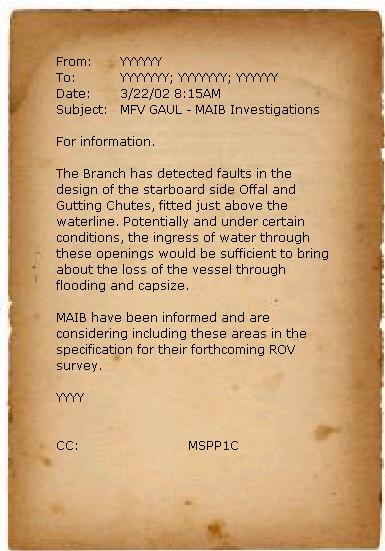
The above paragraph gives a gentle hint, from the Department, that the issues raised in the technical paper do not in fact constitute new evidence; so we will take this as our cue to publish a fragment from one of the items of correspondence, now in our possession, which can, perhaps, shed some light on this matter:


The fragment reproduced above indicates that, even before the RFI, a number of governmental experts, with recognised qualifications and experience, considered the design and construction of the duff and offal chutes on the Gaul to be a cause for concern and advised accordingly.

However, the DfT’s ambiguous reply presents us with an intriguing contradiction: if the design fault theory is not new evidence, then the DfT no longer needs to check it - this must have been already discussed in the past, and the reasons for its dismissal known and capable of being shared with the public.
Otherwise, now that we, together with the DfT, have finally come to the conclusion that this was not new evidence, should we not wonder whether a miscarriage of justice might have occurred?

The main design defect


For a pictorial explanation of the design defect on the Gaul, please follow this link:
http://webzoom.freewebs.com/inconvenientcitizen/Gaul%20design%20fault.pdf
OR

Comments from MAIB

We have received a response from the Marine Accident Investigation Branch. Please see HERE.

Parliamentary Questions and Answers (III)

1 Nov 2006

FV Gaul
"Sandra Gidley: To ask the Secretary of State for Transport if he will examine recent evidence and decide whether the formal investigation into the loss of the FV Gaul should be re-opened. [97993]

Dr. Ladyman: The Re-opened formal investigation into the loss of the FV Gaul was conducted with unprecedented thoroughness. The evidence was scrutinised by leading experts in the fields of oceanography, naval architecture and engineering.
There is no reason to doubt the outcome of the expert analysis that led to the RFI’s conclusions, and consequently there is no reason to reopen the investigation."


Asked the same question by us, the DfT send us the following answer in their letter dated 7.11.06:
"The investigation was conducted with unprecedented thoroughness on behalf of the FV Gaul’s crew, her master and mate, and the Department for Transport (DfT). The evidence – which included video footage of the wreck, as well as new model tests carried out at MARIN in the Netherlands – was scrutinised by leading experts in the fields of oceanography, naval architecture and engineering.

Whilst acknowledging the criticism that has been expressed towards the findings of the RFI, there is no reason to doubt the outcome of the thorough and expert analysis that led to the report’s conclusions and consequently there is no reason to reopen the investigation)."
The Secretary of State for Transport had, in fact, been asked whether or not he was going to examine the recent evidence, which pointed to a design defect in the construction and arrangement of the duff and offal chutes on the Gaul, and decide on the need therefore, of re-opening the formal investigation.
Dodging the actual question, the minister refers instead to the other, former, evidence, which was presented during the 2004 formal investigation, and which, he states, was scrutinised by leading experts*.
The minister knows very well that as long as there is no official appraisal of the evidence that we have provided, there is no need to reconsider the outcome of the Re-opened Formal Investigation.

---------------------------------------------------------------------------------------------
* As a matter of interest, it should be explained that the evidence that was admitted during the 2004 formal investigation was collected and reviewed by the Treasury Solicitor (who acted under instructions from the Attorney General) prior to being brought to the attention of the retained experts.
---------------------------------------------------------------------------------------------

Letter from the Department for Transport

We have recently received an emailed reply from the Department for Transport (DfT):

http://www.freewebs.com/inconvenientcitizen/dftletter7nov.htm

The reply was of unattributed authorship and did not bear the usual DfT logo and header. Anyway, we assume that its contents would have been given some form of ministerial approval prior to dispatch.
The response was entirely as expected, apart from the disappointment of having taken nearly eight weeks to arrive.
The reply fails to address the design fault issue that was put forward in our paper, but merely reiterates the conclusions of the RFI. The DfT also carefully avoids to comment on whether this fault in the duff and offal chutes has been examined (either prior, during or subsequent to the 2004 investigation).

Now, we would like, in our turn, to comment on some of the points that are made by the Department:
“The investigation was conducted with unprecedented thoroughness………. The evidence……… was scrutinised by leading experts in the fields of oceanography, naval architecture and engineering.”
Yes, the investigation was thorough, but not consistently so. The critical areas – i.e. the duff and offal chutes - were not examined in depth.
“…….the FV Gaul and her sister ships were built under Lloyd’s approval, with the same duff and offal chutes design. On the sister ships these chutes survived under similar conditions and were retained until the end of their service.”
Ipse dixit. However, we don’t quite accept that the validity of a claim automatically follows from the authority of its source.

As to the sister vessels, the Department’s argument, which suggests that the design was satisfactory, is not sound. Our posting of 8 November (below) explains why.
“18.17 … it is important to note that although both chutes were found to be open both in way of the non-return flap and the internal top cover, there is no known mechanical reason why this was so. Both could have been closed or, if jammed, could have been freed. In any event the top lids exhibited nothing during the 2002 survey to prevent them from being closed and secured using the butterfly clips.
The design and operation of the chutes was therefore considered by the RFI.”
The information given to the DfT shows that there are credible alternative reasons, for the covers and flaps to be open.
Yes, the design and operation of the chutes was considered, but only in passing and not along the lines suggested in our paper.
“Whilst acknowledging the criticism that has been expressed towards the findings of the RFI, there is no reason to doubt the outcome of the thorough and expert analysis that led to the report’s conclusions and consequently there is no reason to reopen the investigation.”
We disagree. Reasons for re-examining the outcome of the formal investigation are presented in our paper, which is published online at:
The paper is detailed and includes pictorial explanations and evidence of shortfalls in the RFI.
Here is an extract from the 1995 Merchant Shipping Act, which will remind the Minister that the possibility of getting it wrong, the first or even second time around, has been anticipated and provided for in law:
Re-hearing of and appeal from investigations

269.—(1) Where a formal investigation has been held under section 268 the Secretary of State may order the whole or part of the case to be re-heard, and shall do so—
(a) if new and important evidence which could not be produced at the investigation has been discovered; or
(b) if there appear to the Secretary of State to be other grounds for suspecting that a miscarriage of justice may have occurred.
“In closing, I would like to echo the sentiments expressed in the RFI’s overview, that the crew of the Gaul should now be left to rest in peace undisturbed by the speculation created by their dramatic disappearance.”
The government’s argumentum ad misericordiam to defend the outcome of the RFI is inappropriate and, considering that this put the blame squarely upon the victims, rather cynical.

Parliamentary Questions and Answers (II)

1 November 2006

Torremolinos Convention

"Sandra Gidley: To ask the Secretary of State for Transport what plans he has to ratify the International Marine Organisation’s Torremolinos Convention. [97992]

Dr. Ladyman: European Directive 97/70/EC implemented a harmonised safety regime based on the 1993 Torremolinos Protocol. The safety standards were subsequently enhanced by Directive 2002/35/EC. The Government consider these standards exceed the requirements of the Protocol and that its ratification is therefore no longer necessary."

Gadfly: It is suggested that there are three reasons why the UK should attach more importance to the 1977 Convention and 1993 Protocol:
 
1. Safety: There are about 24,000 fatalities in the world fishing industry annually. While the UK fishing fleet meets the safety provisions that are required by the Torremolinos Convention, failure to ratify this Convention at the International level contributes to the fact that sub-standard, foreign flagged vessels and fishermen will continue to be lost.

2. Economic: The UK‘s fishermen have to operate within a regime that is tightly regulated and this has a price. They also have to compete in a world market in which unregulated vessels, having lower overheads, are also able to land fish and this both reduces fish stocks and undermines market prices.

3. Environmental: It is important that fish stocks are regulated effectively and fairly. In this respect, illegal, unregulated and unreported fishing (IUU) continues to be a major problem and one that is contributing to the collapse of fish stocks both in the EU and globally. Ratification and implementation of the Torremolinos Convention is considered by both the IMO (International Maritime Organisation) and the FAO (Food and Agriculture Organisation) to be a key plank in the fight against IUU.

As the Minister advises, the UK has already implemented the EU safety regime, based on Torremolinos, which governs safety matters within the UK’s fishing fleet. Ratification of this Convention at the IMO is a necessary formality that will impose no additional costs on the UK Fishing Industry.

Sister vessels

Yesterday we received a letter from the DfT purporting to answer our previous queries. We will publish it on this site and comment on its contents shortly. For starters, we are addressing the department’s inference that there was no design defect on the Gaul, because the sister vessels, with the same design, did not sink.
“… it should be remembered that the FV Gaul and her sister ships were built under Lloyd’s approval, with the same duff and offal chutes design. On the sister ships these chutes survived under similar conditions and were retained until the end of their service.” (Letter from the DfT dated 07.11.06)
The above comments imply that the duff and offal chutes gave satisfactory trouble free service throughout the lives of the sister vessels. A closer look into this matter shows that, in fact, this is not quite the case.

The Gaul had three sister vessels: Arab, Kelt and Kurd. These vessels are still in service, but none is currently working as a trawler.
Available records show:

1. That the Kappin (ex Arab) is currently working as a fish processing factory freezer ship off the Greenland coast.
The Arab was sold in 1983 and converted into a support depot ship for submersibles; in 1984 it was converted back into a stern trawler. The vessel continued to work as a stern trawler until early 2006 when it was converted into a fish factory ship.

A very good photo of this vessel can be viewed at:
http://www.shipspotting.com/modules/myalbum/photo.php?lid=235426

The vessel was visited in 2003, by the retained experts for the RFI for the purposes of obtaining information that could be of use to the Investigation. The vessels crew were also quizzed at that time (ref. Technical paper presented by the retained experts ‘The loss of the MFV Gaul’ - http://www.bctq.com/isleman.html)
“As part of the RFI, a party visited the FV KAPPIN, a sister vessel to GAUL still fishing from the Faroes. Discussion with the crew revealed that flooding of the factory deck was a recurrent problem. This had been dealt with in part by installing deep well pumps and blanking off the forward offal chute. Even so, crew recounted serious flooding incidents as a direct result of water coming through the aft duff chute. Fortunately this was never catastrophic.”
Does this mean that the crew of the Kappin have also been leaving the chute flaps and covers open?

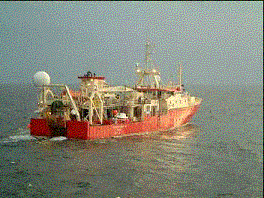
2. That the Bergen Surveyor (ex Kelt) is currently working as a seismic survey vessel for Norwegian owners.
The Kelt was sold in 1982 and initially converted into a support depot ship for submersibles; in 1997 it was converted into a seismic survey vessel.

A very good photo of this vessel can be viewed at: 
http://www.shipspotting.com/modules/myalbum/photo.php?lid=63966

It is most likely that the duff and offal chute openings would have been removed at the time of time of its initial conversion in 1982 (support vessels do not need arrangements for the discharge of duff and offal). The picture shows that, in its current guise, the chute openings are no longer present.

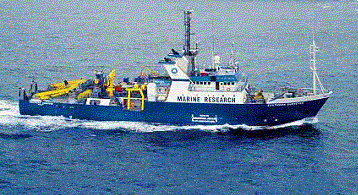
3. That the Southern Surveyor (ex Kurd) is currently working as a marine research vessel and is owned by the Australian Government. The factory deck on this vessel has been converted into a laboratory.
The Kurd was sold in 1983 and initially converted into a support depot ship for submersibles; in 1988 it was converted into a research vessel.

A very good photo of this vessel can be viewed at: http://www.marine.csiro.au/nationalfacility/images/1shipside_lge.jpg

It is most likely that the duff and offal chutes would have been removed at the time of its initial conversion in 1983. The picture above shows that, in its current guise, the chute openings are no longer present.