Showing posts with label DfT. Show all posts

Monday, 4 October 2010

Cowardice and other hindrances

Over the last four years we have published substantive evidence of a miscarriage of justice in the outcome of the Gaul Re-opened Formal Investigation, in which the Court decided that the crew had been responsible for the tragedy while conveniently ignoring serious faults in the vessel’s design and actively suppressing the evidence thereof.
Over the last four years we have dutifully brought these issues to the attention of all relevant authorities and succeeding governments. The past New Labour administrations, naturally, had no interest in addressing them.
But the newly installed government coalition promised us change – change that we understood would be for the better and, as we have recently made some progress (the Met Police had just become slightly more candid and the DfT a touch more sensitive to facts), we thought that appropriate action was forthcoming.


At the same time, however, the left-wing press turned the spotlight on some past minor scandals, rekindled and hyped up to provoke outrage and unsettle the present administration. (And irony of ironies, and amazing coincidence, old John Prescott, the main protagonist in the Gaul and Derbyshire re-opened investigations, was one of the first to jump onto the media circus bandwagon and, becoming suddenly aggrieved with some perceived past infringements to his privacy and loudly condemning the Police indifference to his claims, threatened them with costly legal action.)

All these irate attacks by the political opposition, though irrelevant to the general public, appear, nonetheless, to have made our government lose composure and falter in its commitment to rectify the errors of the past regime.

Failed inquiries, aborted investigations and other unexposed official transgressions seem nowadays to be like stashed away ammunition - ready for use in political battles - or some form of convertible currency, to be traded off on the black market of politics.
For, nowadays, government and political opposition are all part of the same intricate mesh, tightly tangled together in mutual interests, cowardice and ignominy.

Sunday, 12 September 2010

A trip down memory lane

Having recently leafed through some old books about the Gaul, we found an interesting paragraph at page 62 in John Nicklin’s book, The Loss of the Motor Trawler GAUL, which we have reproduced below.


Sadly, Mr Nicklin is no longer with us and will not be able to read copies of two of the official memos that were circulated at that time (see below). These memos provide the answer to his question as to why the Department of Trade, who had commissioned the NMI report on the Gaul, declined to make its findings public.


The last paragraph in the memo above shows that the Department of Trade were not prepared to permit the publication of the NMI report on the Gaul’s stability, for fear that its conclusions might provide evidence to one of the parties to the litigation.


The above memo shows that only after the prospect of litigation had disappeared did the NMI think it likely that the Department of Trade would grant permission to make the results of their research public.

Unfortunately, this is all we have time for at the moment, but we shall come back to this subject (and to the Trident affair) in due course.

Friday, 14 May 2010

The Stability of the Trawler Gaul (part 2)

36 years have passed since the trawler Gaul sank in the Barents Sea on the 8th of February 1974 and 5 years since the Re-opened Formal Investigation into its loss laid the blame for the tragedy with her crew. Today, by way of remembrance, we are going to reveal a few more facts about the stability of the trawler Gaul.

On 5 December 1972 the Department of Trade (DOT) finally completed their examination of the stability of the Ranger Castor (renamed Gaul in 1973) and issued their official stability certificate:


This document was meant to attest that the Gaul’s reserves of stability in her foreseeable sailing conditions had been examined by the DOT and found to satisfy IMCO’s minimum stability standards.
Unfortunately, the stability documentation that had been examined by the DOT prior to their certification of the Gaul contained a number of basic errors and, what is more, it did not reflect the fact that two of Gaul’s seawater ballast tanks had been converted to carry fuel oil. The effects of this conversion were, however, significant for the vessel’s stability because they meant that she could no longer meet the IMCO’s minimum stability standards in all of her operating conditions.


The Original Formal Investigation (OFI)
September - October 1974

In the original formal investigation, the Builders, the Owners and the DOT were all able to draw upon the testimony of their expert witnesses who were well versed in ship stability matters; unfortunately, the same cannot be said for the relatives of the deceased who, instead, had to rely upon the integrity of the Court.

The loss of the Gaul, obviously, raised a number of questions concerning the safety of her remaining sister vessels, and, therefore, a part of the 1974 OFI was spent in considering the safety of the Ranger C class vessels [1] as a whole.

The effect of the ballast tank conversion on the stability of the Ranger vessels was examined in some depth, leading to the agreed view [2] that, even if these vessels sailed with fuel oil (instead of water ballast) in their no 2 Double Bottom tanks, the IMCO minimum stability criteria would still be met provided operational measures (i.e. where the ships’ staff were instructed on the sequence of fuel tank usage) were implemented, and that these would be sufficient to ensure the safety of the remaining vessels.

An extract from the transcripts of evidence for Day 12 OFI:

(Mr Ward represented the Gaul’s builders - Brooke Marine and Mr Gilfillan was an independent consultant Naval Architect who had been engaged by the Gaul’s owners to examine the safety of their Ranger Class vessels.
In the above transcript they were discussing the content of a letter concerning fuel tank usage that had been sent by the owners, shortly after the Gaul was lost, to the skipper of the Kelt, a sister vessel to the Gaul.)

This operational measure (i.e. that the No.2 double bottom tank was to be used only when the ship was fully laden or on her homeward passage) was introduced prior to the completion of Mr Gilfillan’s detailed research into the safety of the Ranger vessels, in which he would draw a different conclusion: namely that - in order to improve their operational stability following the conversion of their no 2 DB tanks for fuel oil - between 20 and 50 tons of permanent ballast should be provided onboard the Gaul’s remaining sister vessels.

Extract from transcripts of evidence Day 11 OFI - 8th October 1974


The lie


In the above extract from the OFI transcripts, it can be seen that the DOT’s counsel (Mr Brice) is asking the witness patently leading questions, suggesting to him that operational procedures would be sufficient to ensure compliance with IMCO stability standards, and also that such procedures were, perhaps, preferable to the provision of 20-50 tones of permanent ballast.

With regard to stability following the conversion of no 2 DB tank for carriage of fuel oil, the shipyard’s hand calculations [3] of 1974 can be readily replicated, and these clearly show that the IMCO stability criteria would not have been met in all of the Gaul’s normal operating conditions, regardless of any diligent skipper’s desire to ensure ‘proper distribution and use of fuel’ and the ‘proper operation of the ship’, as Mr Brice puts it.

Such calculations show that not only was the OFI proposition, that operational measures would suffice, incorrect, but it was also a lie. In carrying out their detailed analyses of the Gaul’s stability reserves, the owners, the builders and the DOT would all have been well aware of the fact that it was not possible for the vessel (as modified) to meet the IMCO minimum stability criteria for the ‘arrival in port’ condition and the seagoing conditions that preceded it.
In fact Mr Gilfillan admits this in paragraph 3 above, but Mr Brice quickly brushes over this fact by suggesting that a lack of adequate stability would only arise if the vessel were “improperly operated”.

(Note: Mr Brice’s rejoinder to Mr Gilfillan’s advice: “but not in all conditions” should have been to seek clarification regarding those conditions in which the vessel did not meet IMCO minimum stability criteria.)

Additionally, the appropriate viewpoint [4] for the DOT, in terms of trawler safety, should have been that an operational solution (which would still retain the inherent risk of human error) for a stability shortfall would always be inferior to a permanent solution that restored a ship’s stability to its desired condition.
The provision of permanent ballast onboard the Gaul’s sisters would have been a permanent solution, and one that would not have affected the vessels’ ability to catch fish or the quantity of catch (470 tons) that they could carry.

The Re-opened Formal Investigation 2004 (RFI)

During the 2004 RFI, the cover-up that had its origins in the 1974 OFI was duly consolidated, orchestrated by the DfT who were familiar with the Gaul case and the issue of her questionable stability.
Additionally, a new cover-up was put in place, one that would also conceal the obvious design faults in the duff and offal chutes on the Gaul and put the cause for her loss down to ‘crew and operator error’.

The cover-up continues to this day.

------------------------------------------------------------
[1] Ranger Cadmus, Ranger Calliope, Ranger Callisto and Ranger Castor (Gaul)
[2] Consensus between the DOT, the Owners and the Builders. It should be noted that all three parties had an interest in obtaining a favourable outcome from the formal investigation, as all could be open to criticism:
- The DOT, who only carried out a superficial document review prior to erroneously certifying the Gaul’s stability in 1972
- The builders, who had produced the Gaul’s stability documentation which contained errors and which over-estimated the Gaul’s stability reserves
- The Owners who had operated the vessel outwith the scope of Gaul’s official stability documentation.
[3] Manual integration of statical stability curves using Simpson’s rules. Calculations have also been carried out using modern ship stability software (with free trim capabilities and automatic free surface correction for tanks) and these show that (after correction for shipyard errors) whenever fishing was poor, the vessel would have had to leave the fishing grounds at a point when approximately 50% of their fuel had been used, to enable them to arrive back in port with more than 100 tons of fuel remaining onboard (this residual weight of fuel was necessary to enable the vessel to meet the IMCO stability criteria on the return voyage). In brief, the conversion of the number 2 Double bottom water ballast tanks for the carriage of fuel oil did not actually extend the operational range of the vessels, it merely substituted fuel oil for seawater, which still had to remain onboard the vessel as ‘ballast’ if minimum stability standards were to be met.
[4] The DOT’s unusual views regarding the provision of ballast become more explicable if we consider that, had permanent ballast been proposed for the Gaul’s sister vessels following the Formal Investigation, then this would have indicated that there had been a fundamental flaw with the Gaul’s stability. Whereas, if safety improvements were required that were of an operational nature only, then it could be argued that the effects of the fuel tank conversion had not been really significant and that the Gaul’s intact stability had been basically satisfactory and that, therefore, the DOT’s certification of the Gaul’s stability documentation in 1972 had not been incorrect.

Contrived ignorance

Our previous post revealed that, according to the Department for Transport, the only advice received by Mr Jim Fitzpatrick, the Transport Minister, in response to our complaint about the Gaul RFI, was the draft of his letter to the Shadow Transport Minister, as jotted down by some unnamed DfT officials.

Forgetting the candid Mr Fitzpatrick for a moment, we turn our attention again towards Mr Geoff Hoon, the Secretary of State for Transport, for it is Mr Hoon himself who is obliged under the provisions of the 1995 Merchant Shipping Act to order a re-hearing of the Gaul RFI, if it “appears” to him that there are “grounds for suspecting that a miscarriage of justice may have occurred”.
In his recent statement (see HERE) the Secretary of State for Transport asserted that there were “no grounds for suspecting that a miscarriage of justice may have occurred” during the Gaul RFI, although - as his own Department currently maintains - the grounds put forward by us have never been properly examined.
In fact, Mr Hoon made sure that no adequate technical counsel was obtained, lest the ‘grounds for suspecting a miscarriage of justice’ would become too ‘apparent’ to him, obliging him to re-open the case. (That is assuming he didn’t know the truth already.)
His contrived ignorance of the matter may also be seen as a precautionary measure taken with a view to escaping future liability: if ever brought to account, Mr Hoon must have reckoned, he would be able to claim lack of knowledge about the technical basis of our arguments.

Thus, like the drug courier who refrains from looking in his suitcase, Mr Hoon has avoided asking for expert advice, shielding his eyes from any unwanted knowledge.
As a lawyer, however, Mr Hoon can be no ingénue in such legal matters and should be aware that this is not how things work in the normal world. Courts are known to have decreed many times in the past that the ignorance-pleading smuggler should have known, and they may likewise, one day, decide that Mr Hoon should have asked.

(Related POST)

Draft advice

The latest answer from the Department for Transport to one of our FOI requests contains an attractive twist.

Our initial query concerned the source of the technical advice given to the Transport Minister, Mr Jim Fitzpatrick, in response to our criticisms of the Gaul RFI.
In response, the DfT informs us that the exclusive source of that ‘advice’, which Mr Fitzpatrick claimed to have received in his letter to the Shadow Minister for Transport, was nothing else but the very draft of that letter – i.e. the one in which he declared himself advised…?!
Génial!! The DfT reply may not be very informative, but, one must admit, it has a notable artistic value.

The common practice, as far as I am aware, given that there are no marine specialists within the Department itself, is to seek technical counsel from one of the DfT’s agencies: i.e. the MCA [1] or the MAIB [2]. The DfT, however, informs us that “no request for additional information was made by the Minister”.
So which officials within the DfT assessed the technical evidence we had provided?

Are we to assume that, perhaps, the Shadow Minister for Transport was corresponding, in fact, with one of Mr Fitzpatrick’s typists?
Is it not more likely that, as it nowadays happens, the Minister outlined his politics-driven decision and then asked the DfT civil servants to draft his response along those lines? Common sense and experience tell us that no official would make ministerial decisions in his place – especially when the issues at stake are both complex and sensitive.

Whatever the case, the statement in Mr Fitzpatrick’s letter: “I am advised that there is no reason to re-open the investigation” now looks as though it had been intended to mislead his Opposition counter-part into assuming that, maybe, a great assembly of experts and scholars had been drawn in to review and offer advice on our criticism of the Gaul RFI.


Put together in one piece, all the correspondence received so far from the DfT looks like a Möbius strip: however attentively you follow it, you will always end up on the opposite side without crossing any boundary – a loop that takes you without interruption from back to front and front to back, without giving you any sign or orientation.
--------------------------------------------------------------
[1] Martime and Coastguard Agency
[2] Marine Accident Investigation Branch

Judge in his own cause

During the ill-famed Hutton inquiry, Geoff Hoon’s conduct was often described as “slippery” and “dishonest”. We couldn’t follow those events very closely, but we can relate how Mr Hoon, now Secretary of State for Transport, has conducted himself recently.

In a letter dated 17 December 2008 (see HERE), Mr Hoon made known his opposition towards a possible re-hearing of the Gaul Formal Inquiry.

In his elaborate message, the Transport Secretary sought to suggest that the evidence and analysis we had provided over the last three years was not of a quality and quantity that would undermine his confidence in the execution of the 2004 RFI. Consequently, with his confidence intact, Mr Hoon considered himself free from any obligation to have the results of the Gaul RFI re-examined.

Back in 2003, if I remember correctly, Mr Hoon didn’t used to be so demanding, and needed a lot less evidence to be able to claim, against the best experts’ advice, that two trailers found in Iraq were ‘mobile weapons laboratories’. That was a different kettle of fish, of course, but Mr Hoon’s variable stance towards evidence standards, somehow, undermines his credibility as trier of fact.


What intrigued us even more, however, was that, this time, Mr Hoon would reveal neither the source nor the substance of the technical advice that had underpinned his decision, offering us no other option than to take him at his word and rest assured that the hint of political embarrassment or scandal was not a factor in his weighty deliberations, deflecting him from his pursuit of the public good.

(We have, of course, replied to Mr Hoon’s letter, and our response can be read at this link or here.)

Sadly, what follows from the Transport Secretary’s position is that, whenever the results of a government-led public inquiry are contested, no matter how compelling the evidence adduced, it is solely up to the government to decide whether or not those results should be re-examined, and it is totally in the government’s power to cloak their decision-making from public view and independent scrutiny.

I wonder, on a large scale, what the consequences of this trend are going to be.

Thursday, 18 December 2008

No records

When Moses received God’s commandments, he didn’t have any paper to write them down on. Still, he dutifully carved them onto clay tablets, which he carried all the way down the mountain to show his people the proof.
More than three millennia down the line, the UK Department for Transport, inexplicably, are not even able to store the instructions received from their earthly superiors, and the reasons behind some of their most important decisions are not kept in any decipherable form.

As already mentioned in a previous post, in response to our FOI request of 4 July 2008, the DfT informed us that they held no specific technical justification [of their decision not to re-hear the Gaul RFI] recorded in any form. Within the same reply, the DfT also mentioned that their earlier decision fully sets out the Secretary of State’s reasoning in relation to the re-opening of the investigation.

Unaware of what that reasoning was, we have formally asked them, via another FOI request (dated 11 September 2008), to provide us with a full account of the reasoning behind the Secretary of State’s decision not the re-open the Gaul Formal Investigation.
The DfT’s response to this latest enquiry, received on 13 October 2008, was astounding. It stated simply that “The department does not hold such an account in recorded form.”

Hmm! From the Department’s contradictory statements we are now left to surmise that either there was no analysis and justification behind their decision not to re-open the Gaul RFI, or that their reasoning has not been ‘set out’ and recorded on any physical media or legible format. It may, therefore, only exist in their heads – in the form of mental images, conceptions, impressions or phantasms. Or, perhaps, it only manifested itself via sensory representations, dispositions, moods or affections.
It is, of course, also possible that the DfT is not telling the truth. But, that would be terribly wicked and unbecoming.

Why no search for the Gaul?

Although the approximate position of the Gaul had been well known, both in official and unofficial circles, in the 23 years that preceded its discovery, successive governments were reluctant to survey the area in question, and to locate and identify the wreck.

It was only in 1997, when TV producer Norman Fenton chartered a vessel and launched a search in the Barents Sea, that the position and identity of the wreck could be confirmed. Finding the wreck took him no longer than six hours. His discovery triggered an obvious question: why had a search for the wreck not been carried out earlier, this would have put an end to much of the speculation and rumours that had surrounded the vessel’s loss and, more importantly, would have helped to ease the grief, frustration and anger felt by the families and friends of those who had perished with the Gaul.

The discovery of the wreck obliged the Government to answer this question; hence, in April 1999, the Deputy Prime Minister, John Prescott, asked Mr Roger Clark, Head of Shipping Policy in the DETR, to conduct an ‘independent’ [1] investigation into why there had been no search for the Gaul after her disappearance in 1974.
Mr Clark applied himself to the task and, a year later, his findings were published in a 60 pages DETR report (see Annex 1).


In brief, the Government’s justification, presented within Mr Clark’s report, claimed that:
Initially we didn’t really know where the vessel was and it would have cost too much to find her and, even if we were to find the vessel, the expense of carrying out an underwater survey of the wreck could not be justified in terms of the benefits it would bring for marine safety.

John Prescott lauded Mr Clark’s conclusions and expressed his total confidence in their soundness and objectivity.

During the 2004 Re-opened Formal Investigation, in response to the victims’ families’ dissatisfaction with Mr Clarke’s explanations, justice David Steel, the Wreck Commissioner, re-examined the arguments, then endorsed, in his turn, Mr Clarke’s earlier conclusions (see the final report of the RFI [2]).

While the official reasoning may appear quite plausible, we have reasons to believe that, in fact, the Government had never been too keen to discover the location of the wreck, not on the grounds advocated by Roger Clarke, but for an entirely different reason: i.e. because a survey of the wreck and an analysis of the evidence that it revealed would have raised questions as to the adequacy of her design. The DfT’s marine experts, it now appears, had long suspected that the arrangement of the duff and offal chutes on the Gaul were a weakness in her design and that this weakness might have been a causal factor in her loss.

(Further details to follow)
--------------------------------------------------------------------------
[1] As head of the DfT’s shipping policy section, Roger Clarke could hardly be considered independent of the government whose actions he was asked to investigate
[2] “We accept the Department’s submission that its actions were solely directed to balancing the interests of those immediately affected by the loss of the GAUL with the wider public interest and the resources available

The Secretary of State's justification

On the 4th of July, we lodged an FOI request with the Department for Transport, asking them to provide us with the reasons and technical arguments underpinning the Secretary of State’s earlier decision not to re-open the Gaul investigation on the basis of our disclosures.
(You can see the full exchange of correspondence at this link: http://www.whatdotheyknow.com/request/evidence_
undermining_the_results)

The DfT eventually sent us their reply in which they stated that the Secretary of State’s decision “fully sets out the Secretary of State’s reasoning in relation to the re-opening of the investigation” and that the DfT held “no specific technical justification [of that decision] recorded in any form

The Department’s statement, short though it is, is pregnant with implied meaning.
Thence we found out that our disclosures and technical arguments made over the past two years have washed over the DfT like water off a duck’s back. This is an admission by the British government that concrete evidence, invalidating the results of a public inquiry, was not considered as required by law. (See also our post of 12 July 2007)
This, of course, is understandable since the Department know very well that the outcome of the Gaul RFI represents a miscarriage of justice, without having to review our evidence. The officials’ obstinate non-engagement with the subject is their way of maintaining the deceit without getting themselves ensnared by their tongues.

Their claim that the Secretary of State’s decision “fully sets out the Secretary of State’s reasoning in relation to the re-opening of the investigation” is already hazarded, and so untrue as to make it laughable.
Given that the response previously received from the Secretary of State only mentions that “the Department is satisfied that there is no reason to doubt the outcome of the expert analysis that led to the Re-opened Formal Investigations conclusions and consequently there is no reason to re-open the investigation”, the DfT’s latest statement can only be taken as a crude parody or as a blunt admission that this is, actually, as far as the Secretary of State’s reasoning powers normally go.

Yet, through its very brevity, the DfT’s reply provides us with further confirmation that the decision not to re-open the Gaul RFI was unlawfully taken and politically motivated.

Another bent thing and more damning evidence

If the evidence we have published so far may have presented “an ostensibly compelling case”, to use Mr Jim Fitzpatrick’s expression from a recent letter, the evidence we will be publishing from now on should provide the Minister for Transport with extra certainty. As, in the same letter, he claimed that the information we presented did not constitute the whole picture – a claim with which, for probably different reasons, we agree - we have decided to show you more of that ‘picture’.

In previous posts we have already argued that the RFI assessment, that the inner lids of the duff and offal chutes on the Gaul had been left open by the crew prior to the loss of the vessel, was unsound. The condition of the closing devices of the duff chute indicates that its inner cover was, in fact, closed when the tragedy struck.

We can now reveal that the split covers of the offal chute were also closed. The images below, captured from the 2002 underwater survey film footage, illustrate that the bar attached to one of the offal split covers, as their means of closure, was found in its place and deformed in a way consistent with it having undergone strong pressure from the underside.

This finding, which the RFI panel was aware of, supports the proposition that the inner lids of the duff and offal chutes on the Gaul had initially been closed by the crew, but were burst open by the force of the incoming waves, at the time of the loss.


We have also constructed a model of the offal chute and tested it against the effects of water pressure acting on the underside of its inner lids. We used this model to replicate the damage to the securing bar, as observed in the images from the wreck of the Gaul. The photo below shows the result.


More to come...

The Minister for Transport

In a recent letter sent by the Department for Transport, Mr Jim Fitzpatrick, the Minister for Shipping, rather than answering our specific questions, took his turn in restating the government’s belief in the results of 2004 Gaul Formal Investigation.

This time round, however, he also claimed that that there was some additional evidence in support of the RFI conclusions - evidence that has never been publicised, which, for some reason, he assumes that we have not yet seen, and which, if it is to be attached any credence, will need to defy the observable facts.
This material was not revealed during the two Gaul formal inquiries, nor did it come to the knowledge of the naval architect who, as an employee of the MCA, has carried out research into the loss of the Gaul since 2002. The DfT claim that they are in possession of this ‘elusive’ evidence, but, alas, … they are not showing it.

Having wondered for almost four years, how the RFI panel had derived their conclusions – whether they had come from esoteric knowledge or from some nebulous fluffs – we are now being told that, basically, it was on this undisclosed evidence that the RFI findings were based. Hmm! Why bother then going through such expensive formal proceedings if that was really the case?
Our curiosity stirred, we would have liked to challenge Mr Fitzpatrick to show us the proof. After all, formal investigations are meant to be public affairs (with disclosure of all relevant facts), held in the public interest.
The Minister, however, seemed unwilling, and, anxious to put a stop to any further questions, he gravely informed us about the wishes of the deceased: “the crew of the Gaul should now be left to rest in peace, undisturbed by the speculation created by their dramatic disappearance”. We must not awake the ghosts and revive the sorrows of the past.

Obstinacy

“The Department is satisfied that there is no reason to doubt the outcome of the expert analysis that led to the Re-opened Formal Investigations conclusions and consequently there is no reason to re-open the investigation,” 
says the message sent to us by the Department for Transport on 8 October 2007.

Herewith, the DfT are once again proclaiming their faith in the merits of the 2004 Gaul RFI which, it is no longer a secret, did not lead to anything, except injustice and discontent, driving the whole purpose of a formal investigation onto precarious ground.

“You have informed me that the technical report, related documents and information published on the following sites: http://the-trawler-gaul.blogspot.com and www.freewebs.com/inconvenientcitizen, had been viewed by technical experts within the DfT before your latest decision not to re-open the investigation was taken.
I would therefore be grateful if you could tell me who these in-house experts are.”
we inquired gently the very same day.

Well, the DfT have, so far, been unable to give us any reply. They need, it seems, legal advice on how to answer the question.

Why take such precautions? We had only asked for the names of the experts involved… Is it because no in-house technical specialists have been in fact consulted? The DfT draw their technical expertise from agencies such as MCA and MAIB. These, as far as we know, have not yet been requested to advise the Department on any of the technical matters that had been raised... Is it because their advice might not be what the DfT would like to hear?
Anxious and unable to either refute our disclosures or renege the schemes of the previous administration, the DfT is therefore stuck, mindlessly repeating the same old line.

While it may first appear as bizarre, their attitude is quite explicable: the system created by our political regime cannot simply over-ride itself in order to correct the wrongs of that regime.
Inhabitants of a closed system, like the one described by the Michelson and Morley experiment, our government departments and their institutional dependants are, moreover, unable to observe the absolute actions of that system from the outside - trapped as they are within their own relativity, and so much preoccupied with self-preservation.

RFI experts' report

In our posts of 28 April and 03 May, we reported on the difficulties of obtaining a document held by the Department for Transport (DfT) – the joint report of the experts in the 2004 Formal Investigation into the sinking of the trawler Gaul.

On 26 June 2007, in a letter sent to Sandra Gidley MP in response to her similar request, Dr Stephen Ladyman, Minister for Transport at that time, wrote:
“The report referred to in paragraph 8 of the Expert’s Protocol is not in a form that can be easily reproduced or transmitted in its entirety. I would be happy to send you any relevant excerpt if you could submit a more specific request for information.”

One month later, on 26 July 2007, in a letter on the same topic, the DfT takes a different approach:
“The Department has sought advice from the Treasury Solicitor’s office on the status of the Joint Panel of Experts report and has been advised that it is not a public document. It was referred to at the RFI but only the transcripts of the various experts oral evidence were actually placed on the GAUL website.
Furthermore, it is accepted that the material prepared for the RFI was prepared on behalf of the Attorney so strictly the Joint Report is the property of the Attorney.
However, the Department can see no difficulty in providing your naval architect with an opportunity to view the Panel’s report but he should be advised that it is not a public document and it will be provided only on the basis that it remains confidential and the property of the Attorney.“
Questioned further on this subject, the Head of Shipping Policy in the DfT told us that the report in question was so confidential that no copy or reproduction of its contents or of any part of its contents was permitted.

Why cannot the public view a technical document, which was created in the course of a public investigation that cost the taxpayer about £10 mil? Although the public paid for it, the record is now owned by the Attorney General who would not even release copies of parts of the document for research and public interest purposes.

Letter to the MCA

The naval architect who was involved in the 2004 Re-opened Formal Investigation into the sinking of the FV Gaul, and is the author of the technical documents that have been published on these pages, has sent a formal email/letter to his employers: Mr Peter Cardy, the new CEO of the Maritime and Coastguard Agency (MCA), Mrs Ruth Kelly (the new Secretary of State for Transport), Mr Laurance O’Dea (Treasury Solicitor) and two other managers within the MCA.

The text of the communication is reproduced below:

Subject: Trawler Gaul

Dear Mr Cardy,
I would like to present you with a problem, the solution for which appears to lie within the gift of both the MCA and the Department for Transport.

The problem stems from the outcome, in December 2004, of the Re-opened Formal Investigation (RFI) into the loss of the Trawler Gaul, the principal issue here being that the results of this public inquiry do not correspond with the evidence that was made available before it.
Although in the normal course of events, the MCA should not and would not be questioning the conclusions of a legal process that has been conducted by the Attorney General's office, in this case, however, there is clear evidence that a miscarriage of justice has occurred.
As you may be aware, this issue is not new, having previously been raised with the MCA, the DfT, the Minister for Transport (via parliamentary questions), the Admiralty Judge who ruled in the RFI and the Treasury Solicitor/Attorney General's office. However, their collective response to date has been either unsatisfactory or to ignore it, probably in the hope that the objections will eventually go away.
I am a Corporate Member of the Royal Institution of Naval Architects and a Chartered Engineer. This Institution's byelaws state that:
Every Corporate Member shall at all times so order his/her conduct as to uphold the dignity and reputation of his/her profession and to safeguard the public interest in matters of safety and health and otherwise.
I consider it unacceptable that being in the Government's employment has brought me into conflict with the standards that are demanded from members of my profession. Furthermore, I find it ethically reprehensible that despite the serious failings in the conduct of this formal investigation, which are apparent, the government has not, as yet, thought fit to remedy this.
To conclude, I do not wish to remain an unwilling party to this miscarriage of justice and I would, therefore, be grateful if you could formally raise this matter with the DfT. with a view to bringing about an appropriate resolution to the case."

When contacted on the phone (several times), Ruth Kelly’s office refused to make any comments on this subject.

COPY OF THE ABOVE MESSAGE WAS ALSO SENT TO THE PRIME MINISTER’S OFFICE.

The experts' protocol

In our post of 17 March, we reported on our attempts to obtain two documents held by the Department for Transport (DfT), which are mentioned in the Gaul RFI EXPERTS' PROTOCOL (paragraphs 3, 8 and 9) and which, frankly, should have been published within the final report (as was the case in the MV Derbyshire RFI).
Having failed to lodge a request for these papers via the parliamentary route, on 19 March, I sent THIS EMAIL to the DfT.

Since then, we have managed to obtain a copy of the first document (i.e. the list of “all” possible scenarios for the loss of the Gaul) from the MAIB. (This list looks quite interesting and we intend to comment on it separately, in due course.)

The second document that we would like to obtain, (i.e. the joint report, which gives details of the RFI experts’ consideration of the various loss scenarios that had been put forward during the investigation), the DfT is still not able to provide.
Chased up on this matter, the head of Shipping Policy 4, not too thrilled to hear from us again, said that the Department was now depleted of staff with intimate knowledge of the Gaul affair, so he had had to refer our request to the Treasury Solicitor. The latter, we were told, is now the only person left at the scene, able to guide the DfT in their search for the document in question.

I hope that the joint report – central piece of the £10m investigation - has not been misplaced or mislaid…

A few essential details that went missing

In any major and costly marine accident investigation, such as the Gaul RFI, one would normally expect lots of data and information relevant to the identified cause of the tragedy to emerge and be made available.
Yet, looking at the government website: www.fv-gaul.org.uk, the sole repository of official information on the Gaul case, one cannot help wondering why so little was published about those things that were pertinent and central to the loss of the vessel, while many tangential issues were generously treated.

Anyway, to make up for the government’s oversight, we have taken it upon ourselves to publish some ADDITIONAL DATA from the vessel’s design plans together with a few detail views of the duff and offal chutes on the Gaul.

These diagrams, apart from adding clarity to the general arrangements on the Gaul and the construction of its chutes, also show that the RFI panel’s claim, that maintenance of the Gaul’s flap assemblies was not possible, is clearly not correct. [This latter aspect has, in fact, already been covered in the full TECHNICAL REPORT.]

Inconsistencies

On the rare occasions when we managed to get a reaction from them, the UK Marine Accident Investigation Branch claimed, hand on heart, that their investigators role in the Gaul RFI had been limited to the mere provision of the underwater survey video footage and technical drawings. The MAIB did nothing more than act as agents” “leaving the retained experts in the formal investigation to draw their own conclusions as to the causes of the accident. This version of events was also backed by Dr Stephen Ladyman, the Transport Minister, in his response to a parliamentary question.

However, Para 3 of the Experts’ Protocol in the Gaul Re-Opened Formal Investigation, which was drawn up in October 2002 and annexed to the 2004 RFI final report, states a rather different thing: A list of all possible scenarios has previously been drawn up by MAIB in consultation with the families’ experts which should form the basis for further work.”, which, somehow, appears to contradict the MAIB’s non-interference claims.

Anxious to solve this inconsistency, we have requested both the MAIB and the Department for Transport that a copy of this list be made available to us. In reply to our request, the MAIB sent us this email. From DfT we haven’t heard anything yet – nothing, except the sound of steps scurrying away from the torchlight.

Parliamentary Questions and Answers (V)

Attention to detail!

The fourth parliamentary question that was addressed to the Secretary of State for Transport concerned the mode and date of implementation of the four safety recommendations arising from the F. V. Gaul Re-opened Formal Investigation.

The Minister’s latest response to this question was very eloquent and reassuring, but, alas, it was also factually incorrect and misleading. The four formal safety recommendations from the RFI have not as yet been implemented and, had it not been for this recent enquiry, it is unlikely that they would have ever been tackled.

One of the principle faults with the Minister’s response, however, is the fact that he seemed to have opened the RFI Report at the wrong page… (!!) that is, he has copied and responded to text from page 280 of the Report, which does not in fact contain the four formal safety recommendations - these are actually detailed on pages 286 and 287 of the formal document.

To assist matters we have reproduced the four safety recommendations together with our further comments on the Minister’s response at this LINK.

Parliamentary Questions and Answers (IV)

8 January 2007

In December last year the Lib Dem MP for Romsey, Sandra Gidley, tabled another set of questions to Parliament. These were meant to shed some light on the vexed issues of the Gaul, which, after previous parliamentary enquiries, still remained unclear.

Sandra Gidley’s requests for information, received by the tabling office on 19 December 2006, subsequently morphed into a slightly different set of questions and were answered by the minister for transport on the 8th of January. (The document published HERE shows both versions as well as the ministerial answers.)

If we compare the last question on the Gaul, submitted to the tabling office in December, with its published version [113499], we cannot help noticing that the formerly closed, narrowly drawn question, meant to elicit an unambiguous 'yes or no' reply, turned into an open-ended inquiry, which allowed the minister enough “wriggle room” to answer as he pleased and keep control of the flow of information. The change of wording from “whether any evidence of design inadequacies, in the construction and arrangements of the duff and offal chutes on the Gaul, relating to: a. The non-return flaps and their possibility of malfunction (i.e. to open under the action of the sea) b. The strength of the inner covers when subjected to direct sea loading, was made available to the Wreck Commissioner...” to “what evidence of design inadequacies in the construction and arrangements of the duff and offal chutes on the Gaul was made available to the wreck commissioner” enabled the minister to get easily off the hook.

The WHAT questions, as any sales professional will be able to confirm, notoriously invite digression.
We must, however, admit that, although open-ended, the question was a lot better than the answer we got. In his reply, Dr Stephen Ladyman kept to the official line and offered nothing extra to what he had stated before. (see the Parliamentary Questions and Answers of 25 October 2006 and 1 November 2006)

Undisclosed evidence

Anxious as ever to alleviate our concerns about the formal investigation into the sinking of the Gaul, we have continued to press the DfT for their views on the technical paper that we had provided and their scientific arguments for dismissing this evidence of a design fault on the Gaul.

The reply from the DfT eventually came (we have published it HERE) and it states:
The report to which your e-mails refers is a document without attribution from a named individual with recognised qualifications and cannot be considered to be either new and important evidence or grounds for suspecting a miscarriage of justice under this Section.” (i.e. Section 269 to the Merchant Shipping Act 1995)
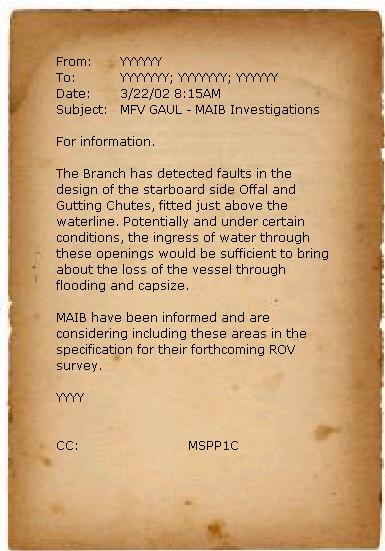
The above paragraph gives a gentle hint, from the Department, that the issues raised in the technical paper do not in fact constitute new evidence; so we will take this as our cue to publish a fragment from one of the items of correspondence, now in our possession, which can, perhaps, shed some light on this matter:


The fragment reproduced above indicates that, even before the RFI, a number of governmental experts, with recognised qualifications and experience, considered the design and construction of the duff and offal chutes on the Gaul to be a cause for concern and advised accordingly.

However, the DfT’s ambiguous reply presents us with an intriguing contradiction: if the design fault theory is not new evidence, then the DfT no longer needs to check it - this must have been already discussed in the past, and the reasons for its dismissal known and capable of being shared with the public.
Otherwise, now that we, together with the DfT, have finally come to the conclusion that this was not new evidence, should we not wonder whether a miscarriage of justice might have occurred?