Showing posts with label offal chutes. Show all posts

Thursday, 18 December 2008

Answers in a fishtail

In our previous posts (27 April, 05 May and 12 June), we have discussed the matter of the inner covers to the offal chute on the Gaul and provided photographic evidence from the wreck which showed that these covers had in fact been secured in the closed position prior to the loss of the vessel and that they could have been opened by the forces of the sea before sinking took place.

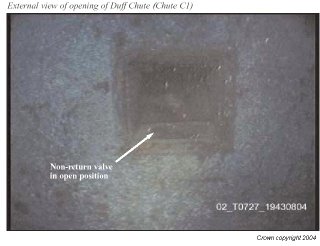
The 2004 RFI panel thought, however, that the offal chute inner covers – found open on the wreck – had been negligently left so by the crew. (The same explanation was employed in respect of the duff chute inner covers, which had also been found open.) (See also this POST)

It must be mentioned here that the regime on the Gaul was such that the operation of offal chute would have fallen under the jurisdiction of the factory manager and his team, while the operation of the duff chute was under the control of the deck crew.
This arrangement gave the RFI experts the opportunity to claim that the factory deck staff, as non-fishermen, had been ignorant about the importance of keeping the offal chute inner covers closed when not in use and, tragically, had failed to secure them at the end of a busy working day.

Unfortunately, the RFI also failed to draw any conclusions from the relevant information that was available to the inquiry. This information relates to the following facts:

1. The offal chute overboard discharge acted as a relief valve during the fish processing operations and, as such, it would only be used when the fish meal plant (rate = 25 tonnes/day) was operating at full capacity or when the fish meal hold was full (capacity = 120 tonnes)
It is also known that the Gaul skipper’s reports recorded that at the time of the loss, the vessel had only managed to accumulate about 20 tonnes of fish fillets onboard together with about 7 tonnes of fish-meal (i.e. a poor catch for the period she was fishing).
The logical conclusion that follows from these data is that there would have been no need for the factory crew to use the offal chute overboard discharge during the vessel’s last voyage.

2. Furthermore two witnesses (Messrs George Petty and Raymond Smith) testified at the hearings that the offal chute would not have been used during the last two voyages in the Gaul’s short life, simply because the fish meal hold was never filled.

More explanations, quotes and details on the subject have been published at this LINK and HERE (diagram).

Like the rest of the conclusions in the 2004 RFI report, the assumption of negligence by all parts of the crew, no matter how implausible, were forced into relevance and given the status of fact.

Photographic evidence

In our posts of 27 April and 05 May we provided photgraphic evidence from the 2002 underwater survey of the wreck of the Gaul showing damage to the closing arragement of the vessel's offal chute's inner covers. This evidence clearly contradicts the final conclusions of the 2004 Gaul RFI.

As previously advised, we are now presenting a video clip which contains further details on this subject, including a model of the offal chute's inner covers and their probable behaviour when subjected to seawater pressure.

Gaul - offal chute inner covers
Video sent by gadflymotion531

Continuation from previous post

The damage to the forked lug (securing clip) of the offal chute lid, which is visible in the image below, indicates that the crew of the Gaul (prior to the loss of the vessel) had secured the inner covers in the closed position. The covers were subsequently damaged when the sea burst them open.


In the above detail, the normal outline of the forked securing clip was drawn in orange

This evidence clearly negates three of the principal conclusions of the RFI:

1. That proper use of the inner covers would have prevented water ingress
This is incorrect - the above photo indicates that the covers had been used ‘properly’ but, unfortunately, this could not prevent the water ingress.

2. That, at the time of the loss, the inner covers were not closed and secured
This is incorrect – the evidence indicates that not only had the covers been closed and secured at the time of the loss, but also that the forces of the sea subsequently opened them.

3. That, at the time of the loss, there was no physical reason to prevent the crew from closing and securing these covers
The photo shows clearly that the securing arrangements were physically damaged and as such could not be used to secure the covers. It is most likely that this damage occurred ‘at the time of the loss’

Besides, the inner covers were in no way strong enough to be watertight. If they had been, they would not have been damaged.

More to come...

Another bent thing and more damning evidence

If the evidence we have published so far may have presented “an ostensibly compelling case”, to use Mr Jim Fitzpatrick’s expression from a recent letter, the evidence we will be publishing from now on should provide the Minister for Transport with extra certainty. As, in the same letter, he claimed that the information we presented did not constitute the whole picture – a claim with which, for probably different reasons, we agree - we have decided to show you more of that ‘picture’.

In previous posts we have already argued that the RFI assessment, that the inner lids of the duff and offal chutes on the Gaul had been left open by the crew prior to the loss of the vessel, was unsound. The condition of the closing devices of the duff chute indicates that its inner cover was, in fact, closed when the tragedy struck.

We can now reveal that the split covers of the offal chute were also closed. The images below, captured from the 2002 underwater survey film footage, illustrate that the bar attached to one of the offal split covers, as their means of closure, was found in its place and deformed in a way consistent with it having undergone strong pressure from the underside.

This finding, which the RFI panel was aware of, supports the proposition that the inner lids of the duff and offal chutes on the Gaul had initially been closed by the crew, but were burst open by the force of the incoming waves, at the time of the loss.


We have also constructed a model of the offal chute and tested it against the effects of water pressure acting on the underside of its inner lids. We used this model to replicate the damage to the securing bar, as observed in the images from the wreck of the Gaul. The photo below shows the result.


More to come...

Elastic conclusions and the re-writing of history

In an earlier POST we already mentioned one embellishment contained in a paper produced by the experts in the 2004 Gaul RFI.
In that same paper, drawn up as a summary of the results of the formal investigation, the experts also went a step beyond the official findings and stated with conviction:
“There was no logical reason why the duff and offal chute lids were secured in the open position, whilst dodging, other than crew error. It is also difficult to understand why the flap valves were jammed in the open position other than bad maintenance onboard or ashore.”

The authors were, of course, well aware of the fact that the offal chute lids had not been found secured in the open position. They were also aware that it was only around the duff chute lid that some kind of ‘ligature’ had been seen hanging and, therefore, one could not truthfully say that both the duff and the offal chute lids had been secured open by the crew of the Gaul.

The RFI final report, having been drawn up by better-versed legal minds, went only as far as advising that:
“In the case of the duff chute, the single lid was apparently secured in the open position by some form of ligature and in the case of the offal chute the split lid was found with the forward half open and the aft half closed, but not secured.”

The RFI experts must have also realised that any future interested parties would be more likely to read their free paper rather than the costly and voluminous RFI report, and that their words may therefore be taken as fact.

In the light our previous post and the above observations we would ask our readers the following question: What can one make of these exaggerations, which, it so happened, had the effect of adding undeserved weight to the Court’s ‘crew error’ verdict?

Another piece of misleading evidence

An important plank in the Attorney General’s case against the crew of the Gaul was the instilled notion that they were not experienced in operating trawlers fitted with hull openings for the discharge of fish processing waste.

The case made was that, because the crew had no experience of such ships, they would not have been able to appreciate the importance of such openings in relation to the vessel’s stability and watertight integrity. Their subsequent ‘errors’ in not maintaining the duff and offal chute’s flaps and ‘forgetting’ to close the inner covers could thus be more readily explained.

The Attorney General’s team developed this theme throughout the course of the hearings (see extracts from the transcripts of evidence in the DOCUMENT ATTACHED), and even went as far as providing a detailed general arrangement drawing for the freezer trawler Cassio (Appendix 7 of the final report), which showed, they said, that duff and offal chutes had not been fitted on that vessel.
A small point to note:

A ship’s general arrangement drawing carries a level of detail that is decided by the draughtsman with clarity, aesthetical and presentational aspects being important considerations. The general arrangement drawing that was presented as evidence to the Gaul RFI merely confirmed that duff and offal chute openings had not been indicated on that drawing, it did not confirm that they had not been provided on the vessel.

In a 1966 photograph of the Othello, possibly on sea trials, its duff and offal discharges, cut in the hull on the port side, can be seen just aft of the funnel and near to the waterline.


The freezer stern trawlers Cassio, Othello and Orsino were sister vessels, built by Yarrows of Glasgow in 1966. The Gaul’s Skipper, Peter Nellist, sailed on both the Cassio and the Orsino, while the Mate, Maurice Spurgeon, had sailed on the Othello immediately prior to joining the Gaul on her last voyage.

Lack of strength

We have previously mentioned that the inner covers of the duff and offal chutes on the Gaul were not designed to be of watertight standard. Our post of 24 September 2007 states that the inner covers of the duff and offal chutes on the Gaul were not watertight, nor were they supposed to be so, and, even closed, they could not have been relied upon to maintain the watertight integrity of the vessel.

We would now like to explain that the main reason why the inner covers on the Gaul were not of a ‘watertight’ standard is because they were deficient in strength.That is the hinges, toggle bolts and steel lugs – the only parts of the covers, which provided the strength or resistance against the forces of the sea – were inadequate.

The paper published HERE gives the details.

A second design error

So far, we have revealed that there were two design faults and one, what we would call, error in the in the design of the duff and offal chutes on the Gaul:
The principal design fault (for details, see this LINKED DOCUMENT and this VIDEO CLIP), related to the construction and arrangement of the chutes, meant that the non-return flaps in the duff and offal chutes on the vessel could have been opened by the action of the sea

The second design fault showed the possibility for the bolted assemblies of the non-return flaps to become twisted due to the force of the sea, and remain open thereafter (further details can be found at this LINK).
The design error described in our post of 26 June 2007 was a dimensioning mistake in the shipyard’s construction drawing which, in certain circumstances, could have caused the flap to jam in the open position, after having been opened under the action of the sea. (For further explanations please follow this LINK)

Now, we are presenting yet another design error (explained HERE as well as HERE): a miscalculation of the relative weights of the components of the chutes’ non return flaps, the consequence of which meant that a wave load of only 7.5 kg could have been enough to force them open.

It should be noted that the design of ‘non-return flaps’ within the duff and offal chutes should have enabled them to withstand the forces of the sea, close automatically and prevent water ingress. However, as a result of the inadequacies listed above, the action of the sea could have caused the flaps to fail in their main functions.

Thus, it is evident that the design of the Gaul’s chutes was vitiated by multiple flaws (and, we warn you, there is more to come) and that the unfortunate nature of these flaws was such that they augmented each other’s effects, rendering the vessel unacceptably vulnerable to flooding and capsizing.

A design error

"18.17... it is important to note that although both chutes were found on the wreck to be open both in way of the non-return flap and the internal top cover, there is no known mechanical reason why this was so." (Report of the 2004 Re-opened Formal Investigation into the Loss of the FV Gaul)
In the paper describing the MAIN DESIGN FAULT on the Gaul, we gave an account of how the closed flaps of the duff and offal chutes on the vessel could have been forced open by the sea at the time of the incident. (You can also see a model of the design fault captured on this VIDEO clip).

Furthermore, the factor tree analysis diagram, published earlier on THIS PAGE, presented a range of alternative explanations, as to how the outer flaps of the duff and offal chutes on the Gaul could have become open and remained in the open position (the RFI having only examined and accepted that the flaps were open, prior to the vessel’s departure from Hull, as a result of corrosion and lack of maintenance).
One of these alternative explanations (i.e. THE SECOND DESIGN FAULT), mentioned in an earlier POST, put forward the possibility that the bolted non-return flap assemblies within the chutes could have become twisted due to wave action and remained open as a result.

Today, we are presenting another alternative explanation, whereby a simple dimensioning error in the shipyard’s construction drawings meant that, if ever the brass gland within the flap hinges was loosened by the operation of the flap, parts of it could have bound together, thus causing the flap to remain seized in the open position.
THIS PAPER gives the details. (The document can also be viewed HERE)

Compliance with the rules (Part II)

In our previous post we indicated several non-compliances with the safety rules pertaining to the construction of the Gaul’s duff and offal chutes.


We are now reporting on further non-compliances with the rules, details of which have been published within this DOCUMENT.

Back garden model testing

At the end of the 2004 RFI, the wreck commissioner opined:
“[…] it is important to note that although both chutes were found on the wreck to be open both in way of the non-return flap and the internal top cover, there is no known mechanical reason why this was so. [1]
This viewpoint has recently been echoed by the the Treasury Solicitor who said:
there was no evidence that the chutes had been forced open by wave or water action so this was not advanced as a loss scenario by the experts
Having enjoyed the benefits of a sunny weekend, we decided to construct a small-scale (and cheap) model of the chutes and test them with a hose. The results of this simple experiment provide a clear illustration of the SCENARIO whereby the design fault in the duff and offal chutes on the Gaul caused the flooding and loss of the vessel.

Simple mechanics!
_____________________________________________
[1] Report of the Re-opened Formal Investigation into the Loss of the FV Gaul

(The video file can be dowloaded from this SITE (2.9 Mb))

A few essential details that went missing

In any major and costly marine accident investigation, such as the Gaul RFI, one would normally expect lots of data and information relevant to the identified cause of the tragedy to emerge and be made available.
Yet, looking at the government website: www.fv-gaul.org.uk, the sole repository of official information on the Gaul case, one cannot help wondering why so little was published about those things that were pertinent and central to the loss of the vessel, while many tangential issues were generously treated.

Anyway, to make up for the government’s oversight, we have taken it upon ourselves to publish some ADDITIONAL DATA from the vessel’s design plans together with a few detail views of the duff and offal chutes on the Gaul.

These diagrams, apart from adding clarity to the general arrangements on the Gaul and the construction of its chutes, also show that the RFI panel’s claim, that maintenance of the Gaul’s flap assemblies was not possible, is clearly not correct. [This latter aspect has, in fact, already been covered in the full TECHNICAL REPORT.]

Another small observation

The 2004 Formal Investigation into the sinking of the FV Gaul concluded, as we all already know, that the cause for the loss of the vessel was the ingress of a large quantity of seawater through the two duff and offal chutes openings in the hull of the vessel.

The double-barrier protections of these openings – the inner covers and the outer flaps - were found to be in the open position during the underwater survey in 2002.
The fact that the outer flaps were found open, the investigation concluded, was due to seizure caused by corrosion in the vessel’s 16 month old flap hinges and failure on the part of the crew and shore maintenance staff to identify and rectify this problem.
The fact that the inner covers were also found open was explained away by crew negligence.
However, the trouble with these findings (as we have attempted to explain in our earlier posts) is that they were based on unsubstantiated assumptions.

Let’s take, this time, the presumed corrosion at the flap hinges. (For a few more details on this issue please click HERE.)
As the same combination of materials, mild steel and brass, had been used in a number of other structures on the Gaul (e.g. for the toggles and clips on all weathertight hatches and doors), one would expect similar corrosion problems in those areas.
In reality, though, this doesn’t seem to be the case.
Quite the reverse, as the following clips[1] show, even after 28 years under the sea, the toggles and clips on the Gaul did not present such a level of corrosion and seizure that would prevent them from being easily unscrewed by the ROV[2] arm.
.......................................................
[1] Extracts from the 2002 MAIB video footage - © Crown copyright
[2] Remote Operated Vehicle


weathertight hatch mild-steel clips & brass bush


weathertight hatch brass toggle & steel toggle bolt


weathertight hatch brass toggle & steel toggle bolt

The second design fault

In our previous post we provided a LINK to a factor tree diagram, which presented the various alternative explanations as to why the outer non-return flaps in the duff and offal chutes were found in the open position during the 2002 underwater survey on the Gaul.
We have also published a simple pictorial explanation of the PRIMARY DESIGN FAULT in the vessel's chutes.

Now we are publishing a document, which reveals a second design fault in the construction of these chutes (please click SECOND DESIGN FAULT or HERE to find out more).
This additional design fault, demonstrated in the above-mentioned paper, gives weight to the possibility that the bolted flap assemblies within the duff and offal chutes became twisted due to wave loading and remained open thereafter. (See item (14) on the factor tree diagram).


Are the conclusions arrived at by the Gaul investigation panel (i.e. that the vessel’s chutes had been left open by the crew and shore staff for 59 days before the accident occurred) supported by any credible proof?

The main design defect


For a pictorial explanation of the design defect on the Gaul, please follow this link:
http://webzoom.freewebs.com/inconvenientcitizen/Gaul%20design%20fault.pdf
OR